Japan ex-FM Kawaguchi praises President Tokayev’s UN reform vision
Yoriko Kawaguchi hailed Kassym-Jomart Tokayev’s UN reform vision and his contribution to Japan-Kazakhstan ties in a Silk Way TV interview, Qazinform News Agency reports.
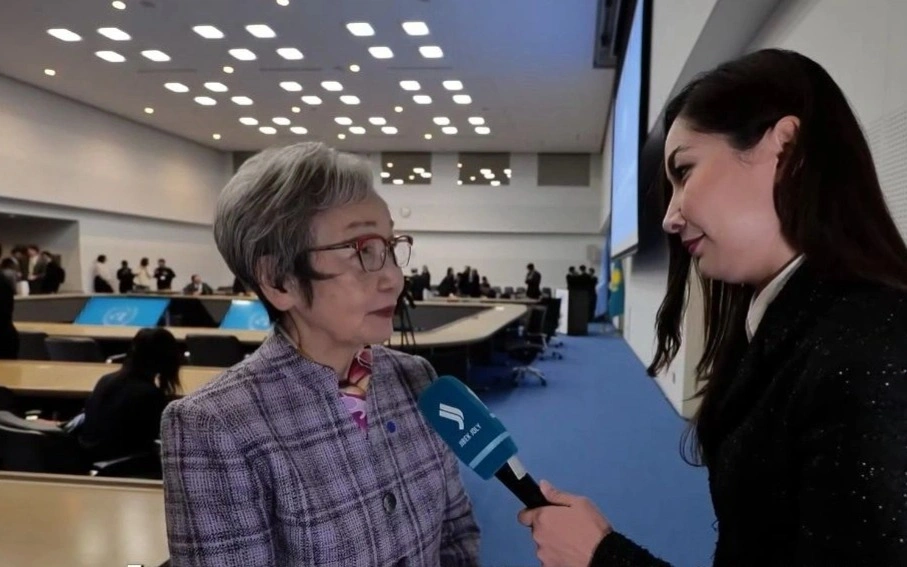
Former Japanese Foreign Minister Yoriko Kawaguchi shared her views on Kazakh President Kassym-Jomart Tokayev’s lecture at the United Nations University, highlighting his contribution to the development of bilateral cooperation.
— The lecture by the President of Kazakhstan included several topics. Let's talk about, for example, the UN and the need for reforms in the Security Council and to make it more represented by the 'middle powers.' What are your thoughts on that? Are you in line with the President and his message of unity of purpose, in the spirit of Japanese philosophy? What do you think about it? How can we save and maintain this balance thanks to the cooperation we have, for example, with Japan?
— Yes. Well, first of all, I have to say that I was quite impressed with his entire speech. He covered a wide range of subjects, including what you talked about: the UN, our bilateral relationship, his thoughts on reform of his country, and also of the world institutions. I like his thoughts very much personally, and I think he could lead the initiatives to enlist other countries, to work toward that way.
As he emphasized, the UN needs to be reformed, and there should be no delay in doing this. It's important that not only the major countries, the P5, but other nations, and, I think, middle-sized countries, as you questioned, have a large role, a big role to play.
Right now, there are 193 countries in the UN. The central part is the majority. The "Big Five" are at the top, but just down below are the middle-sized countries. They should certainly be given a larger role to play. I agree with that. There are many thoughts and time, I think, is needed, but discussions should be started, and the Security Council should be worked out. It has to be done. It's so difficult, but it has to be done.
— What do you think in general about the role of Kazakhstan as, you know, in its foreign policy? The President also spoke about this mediating capacity and this very multilateral diplomacy. Is it a role to play in the future for Kazakhstan in this international community?
— Yes, definitely. Multilateralism is being eroded right now, but it is important. If we don't bring that back, we go into the chaos — the competition of powers. But multilateralism is the rule creation, the order creation. We may not be, for the time being, able to bring all the elements back, but some of them we need to bring back and make functioning here.
Kazakhstan is the regional power, a leader of the region of Central Asia, and its foreign policy looks beyond the region. Of course, I understand that it's talking about the Abraham Agreements [Accords], and I think it is a good move. Kazakhstan is assisting other countries, has started to assist, and has created the aid institution. These moves show that Kazakhstan is thinking of the whole world and then moving, being concrete about doing its mission. I fully support it. I am very happy that it's being done.
— And finally, ahead of the 'Central Asia + Japan' Summit, which will be held tomorrow, what are your expectations of the outcomes?
— I am glad that it has come to that stage. As I was listening to President Tokayev's speech, that cooperation, with the growth of Central Asian countries, and also the changes in technology and bilateral relationships, has come to the second stage — we can move to the next stage. I am really interested in seeing what will come out of tomorrow's meeting.
Earlier, Qazinform News Agency reported that President Kassym-Jomart Tokayev gave a lecture at the UN University in Tokyo titled as “Restoring Strategic Trust in an Era of Turbulence: How Kazakhstan Envisions a Fairer and More Stable World.”
Recall that the Kazakh President arrived in Japan on an official visit on December 17.
On December 18, President Tokayev held talks with Emperor Naruhito of Japan in Tokyo. The Kazakh President said that the two countries are bound by longstanding friendly relations based on mutual respect and fruitful cooperation across various fields.
On the same day, Kassym-Jomart Tokayev visited Meiji Jingu Shrine, the largest Shinto shrine in Tokyo, had meetings with the citizens of Kazakhstan currently studying or working in Japan, and with the members of the Japanese Parliamentary League of Friendship with Kazakhstan led by Toshiaki Endo. The Head of State highly appreciated the activity of the League, saying that he viewed it as an important mechanism of strengthening the bilateral cooperation.
Then, the Kazakh leader held talks with Japanese Prime Minister Sanae Takaichi.
The meeting ended with signing 14 documents.
On Friday, December 19, Kassym-Jomart Tokayev met with Tokyo Governor Yuriko Koike. The two sides discussed cooperation in digitalization, the development of Smart City technologies, artificial intelligence, sustainable urban development, and the introduction of innovative solutions in city management.
Later, in the presence of the Kazakh President, Astana Mayor Zhenis Kassymbek and Tokyo Governor Yuriko Koike signed a Memorandum of Understanding between the capitals of Kazakhstan and Japan.
The Head of State also had meetings with Shingo Ueno, Representative Director, President and CEO of Sumitomo Corporation, Chairman and CEO of Japan Organization for Metals and Energy Security, Ichiro Tahakaru, Hiroyuki Ogawa, Chairman of the Board of Directors of Komatsu Ltd, as well as President of Hitachi Construction Machinery, Masafumi Senzaki.
President Tokayev joined CA leaders at an official reception by Japanese PM Sanae Takaichi.