Almost 13% of Kazakhstan’s oil is supplied to European market
President Tokayev stated Kazakhstan’s readiness to serve as a reliable partner for Europe in the field of critical minerals, Qazinform News Agency learned from the Akorda press service.
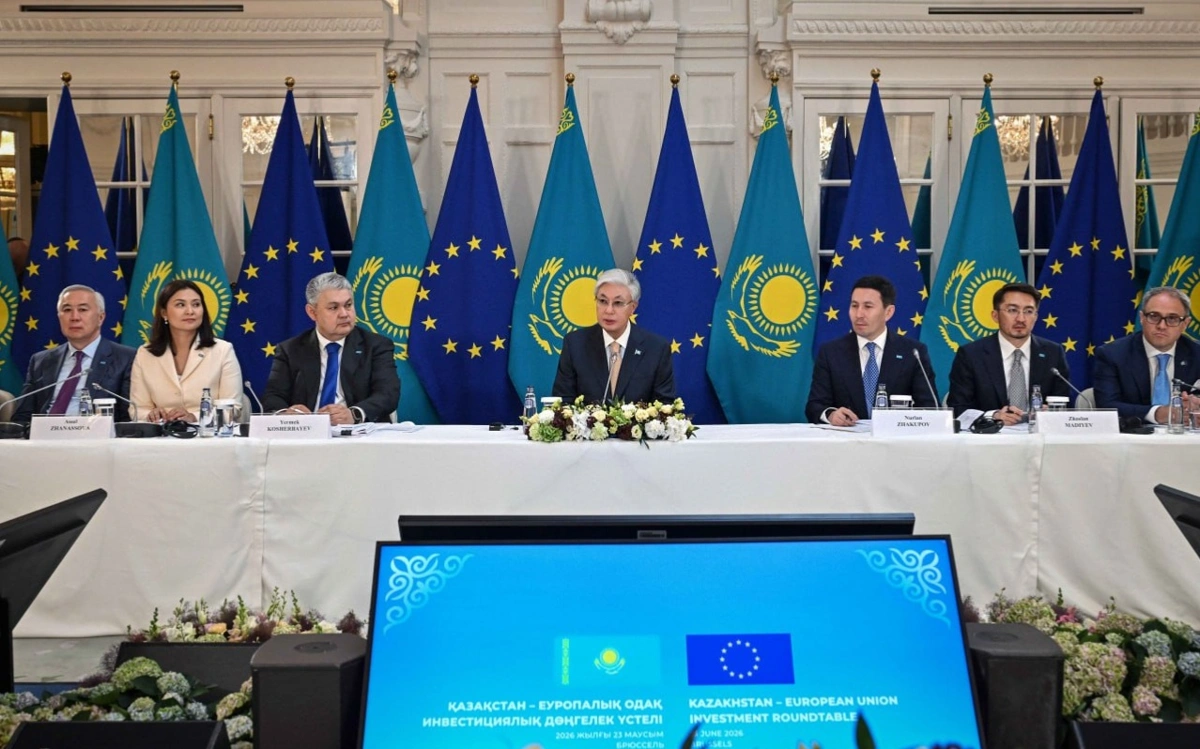
“Kazakhstan is ready to supply 21 of the 34 minerals included in the EU’s list of critical raw materials. To fully utilize this potential, we propose a cooperation model based on offtake agreements. This will foster domestic processing and the creation of high value-added industries. As a result of this partnership, a Regional Research Center for Rare Earth Metals will be established. At the same time, Kazakhstan remains committed to advancing the global energy transition. As is known, our country is the world’s largest producer of uranium, ensuring about 40% of global demand. Alongside significant reserves of oil, gas, and coal, we are actively developing projects for the production of green hydrogen. In addition, Kazakhstan possesses substantial undeveloped reserves of lithium, nickel, vanadium, and cobalt. Ultimately, we offer our partners a pragmatic formula: ‘investment and technology in exchange for access to strategic resources,’ in full compliance with European standards,” the President noted.
According to the Head of State, Kazakhstan is consistently strengthening its strategic position as a reliable partner and guarantor of the European Union’s energy supply.
“Over the past year, the share of Kazakhstan’s crude oil supplied to the European market amounted to almost 13%. We reaffirm our unwavering commitment to expanding cooperation with European partners, aimed at increasing supply volumes and enhancing regional energy security. In this regard, ensuring the stable and reliable operation of the Caspian Pipeline Consortium remains a key strategic priority,” Kassym-Jomart Tokayev emphasized.
The President also highlighted that the country’s industrial sector forms a solid foundation of the economy, ensuring sustainable growth and diversification.
“Last year, the share of the manufacturing sector in our GDP reached nearly 27%. We launched more than 190 new production lines. It is highly commendable that European companies are actively engaged in the development of our industry. Economic cooperation between Kazakhstan and the EU has undergone fundamental changes, shifting toward deep localization and integration of high value-added production chains. These examples demonstrate the significant potential of Kazakh-European industrial cooperation. In this context, I would especially like to note the contribution of European financial institutions, primarily the European Bank for Reconstruction and Development (EBRD) and the European Investment Bank (EIB),” Tokayev said.
As it was reported, on Monday, June 22, President Kassym-Jomart Tokayev arrived in Brussels on an official visit.
The Head of State met with citizens of Kazakhstan currently studying or working in Belgium.
Ahead of talks with EU leaders, Kassym-Jomart Tokayev held an informal meeting with European Council President António Costa.
On Tuesday, the Head of State had a meeting with Prime Minister of Belgium Bart de Wever.
During the talks with EU leaders António Costa and Ursula von der Leyen at the Europa building in Brussels, President Tokayev emphasized that relations between Kazakhstan and the European Union have reached their highest level in the history of bilateral cooperation.
Kassym-Jomart Tokayev placed special emphasis on strengthening transport and logistics ties.
The President of the European Council noted that Kazakhstan's geographical location, unique history and culture make the country a bridge between Europe and Asia.
Following the talks in Brussels, Head of State Kassym-Jomart Tokayev, European Council President António Costa, and President of the European Commission Ursula von der Leyen adopted a joint statement.
Kassym-Jomart Tokayev also addressed the "Kazakhstan-EU" roundtable meeting in Brussels held with the participation of the representatives of business community of EU member states. He announced that during his current official visit to Brussels, commercial agreements worth more than $12 billion are will be signed.