Kazakhstan strengthens Middle Corridor role as Tokayev advances Caspian cooperation
Kazakhstan’s drive to develop the Middle Corridor gained new momentum on October 15, when Astana and Baku agreed to deepen cooperation on the Trans-Caspian route. The agreement adds a practical dimension to President Kassym-Jomart Tokayev’s sustained diplomatic efforts to establish Kazakhstan as a central link between Asian and European markets, Qazinform News Agency correspondent reports.

The economic stakes
The Trans-Caspian International Transport Route (TITR), known as the Middle Corridor, connects China with Europe through Kazakhstan, the Caspian Sea, Azerbaijan, Georgia and Türkiye. Interest has grown since 2022 as disruptions to established trade routes encouraged businesses to diversify their supply chains.
For Kazakhstan, the opportunity extends beyond collecting transit fees. Greater connectivity could support logistics, manufacturing, warehousing and exports, provided the country can turn its geographical position into dependable transport services.
A September 2026 World Bank report estimates that targeted investment could more than triple trade along the corridor by 2040 and halve transit times. Across nine participating countries, the resulting gains could add 3.3% to GDP and create approximately two million jobs. With additional trade facilitation reforms, volumes could quadruple and travel times could fall by two-thirds compared with 2023.
The investment requirement is substantial: more than $25 billion for core infrastructure through 2040, alongside approximately $30 billion for supporting facilities and equipment.
The World Bank particularly stresses logistics coordination. Fragmented border procedures and inconsistent service standards can absorb much of the time saved by faster rail connections. Improving the route therefore requires governments, railway operators, ports and shipping companies to act together.
Railways, highways and ports
Kazakhstan is expanding infrastructure across the corridor's eastern and Caspian sections. According to official data, TITR freight volumes reached 4.48 million tons in 2024 before easing to 4.12 million tons in 2025. Container traffic, however, increased by 36% in 2025 to around 77,000 TEU.
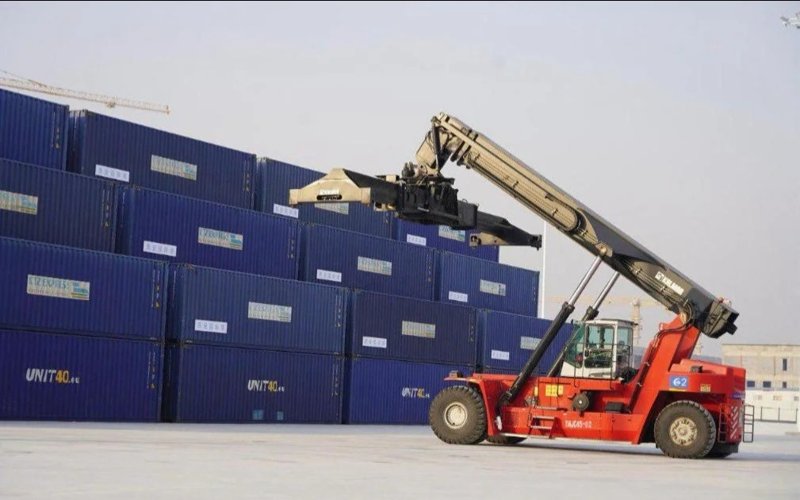
That distinction matters. Containers are particularly important for higher-value, time-sensitive trade, whereas total tonnage can fluctuate with bulk cargo demand. The figures suggest progress in a segment central to the corridor's competitiveness, although overall growth has not been uninterrupted.
The latest figures indicate renewed growth. Freight movement along the route rose 22% year on year during January-August 2026, while East-West transit through Kazakhstan increased by 55%.
Major railway projects are intended to accommodate further demand. Additional tracks on the Dostyk-Moyynty section have been completed, while the Moyynty-Kyzylzhar and Darbaza-Maktaaral lines are nearing completion. The Bakhty-Ayagoz railway, another connection to China, is scheduled to enter service in 2027. Kazakhstan reports that it has built or modernized approximately 5,000 kilometers of railway over the past five years.
Road transport is part of the same effort. Construction of the more than 1,500-kilometer Aral-Caspian highway began in August. Tokayev has said it could shorten the China-Europe road corridor by roughly 1,000 kilometers and reduce the time required to move freight across Kazakhstan from five days to three.
Investment is also reaching the Caspian coast. Aktau commissioned a container hub developed with China's Lianyungang Port, while Kazakhstan's SEMURG INVEST and MSC Group's logistics arm MEDLOG are working on the Sarzha logistics cluster at Kuryk. The project envisages up to five million tons of additional annual handling capacity and 110,000 TEU of container throughput.
Together, these projects address a basic requirement for the corridor: higher capacity on land must be matched by efficient connections to maritime services. Otherwise, improvements to rail and road networks risk being offset by delays at the Caspian crossing.
Tokayev's transport diplomacy
The infrastructure program is accompanied by an increasingly prominent transport agenda in Kazakhstan's foreign policy. Tokayev has raised the Middle Corridor in discussions with Asian and European partners, positioning it within a broader network of Eurasian routes rather than as a replacement for existing connections.
At the first Central Asia-Republic of Korea Summit in September, he outlined a target of 100 million tons of total annual transit through Kazakhstan and called for expanding the Middle Corridor's capacity to 20 million tons. He also proposed closer links between South Korea's Port of Busan and Kazakhstan's Caspian ports.
During a visit to Germany, Tokayev and President Frank-Walter Steinmeier affirmed the route's strategic importance. Meetings with Deutsche Bahn and Rhenus Group focused on railway and logistics cooperation. The developing partnership between SEMURG INVEST and MEDLOG also followed the Kazakh President's discussions with MSC leadership in Brussels in June.
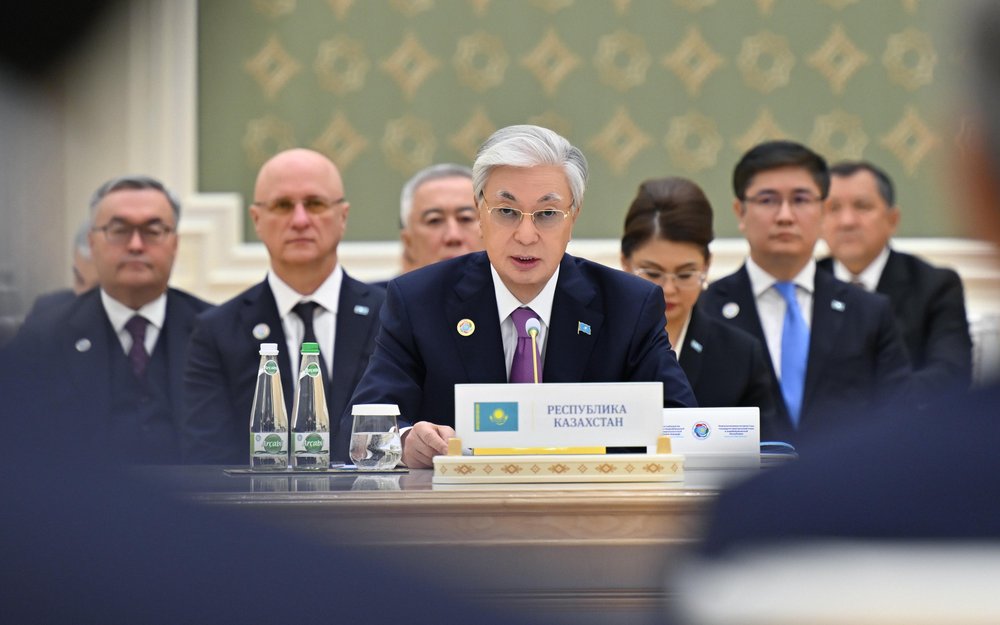
Regional diplomacy has been equally active. At the October 8 Consultative Meeting of Central Asian and Azerbaijani leaders in Awaza, Tokayev proposed examining potential links between the Middle Corridor and the TRIPP initiative in the South Caucasus. At the CIS Summit the following day, he referred to a concept for integrating transport corridors adopted in May at Kazakhstan's initiative.
In Baku on October 15, he proposed a CICA Transport Connectivity Strategy encompassing the Belt and Road Initiative, the North-South route, the Middle Corridor and TRIPP.
This consistent focus gives Kazakhstan's infrastructure projects a wider diplomatic context. It also reflects Astana's interest in maintaining multiple transport partnerships, including the North-South route involving Russia, while seeking a larger role in East-West trade.
Such continuity gives international partners a clearer picture of Kazakhstan's priorities and creates opportunities to translate political agreements into investment and commercial cooperation. The next measure of progress will be how quickly these commitments produce additional capacity and more reliable services.
The Caspian constraint
The corridor's most complicated section remains the Caspian crossing. Freight must transfer between railways, ports and vessels, making schedules vulnerable to limited ship availability, shallow approaches, handling delays and differences in administrative procedures. New rail capacity can deliver its full benefits only if cargo can cross the sea predictably.
The October 15 agreement between Kazakhstan and Azerbaijan addresses several of these problems. Exchanged by the countries' ministers in the presence of Tokayev and Azerbaijani President Ilham Aliyev, it establishes a legal framework for closer coordination on rail, road and port infrastructure.
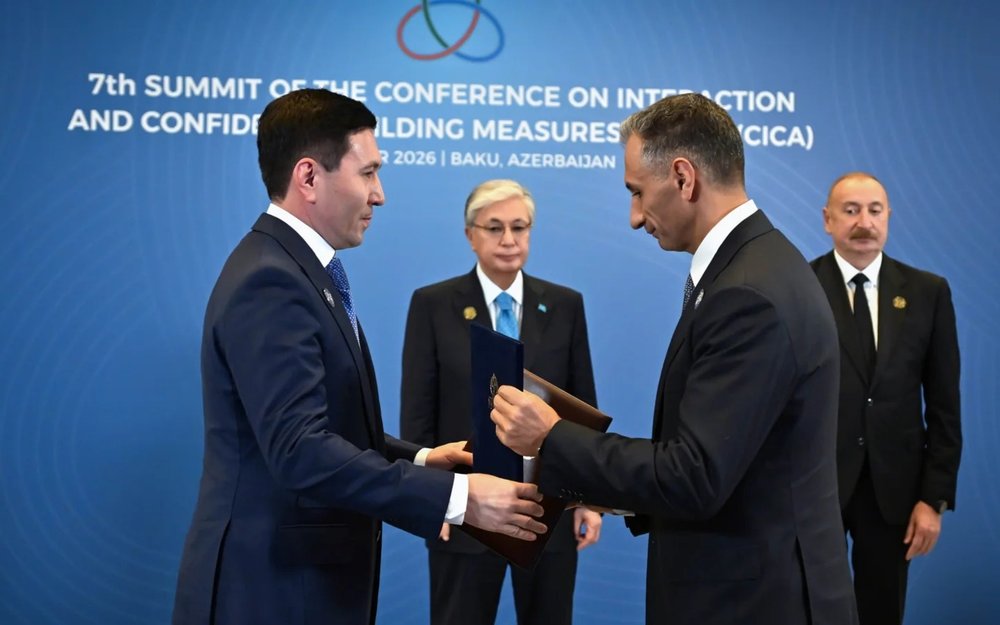
The agreement provides for removing bottlenecks, developing dredging capabilities and expanding maritime transport. The two sides also exchanged documents concerning the acquisition of two dry-cargo vessels, a practical step toward addressing shipping constraints.
Equally significant are the proposed digital measures, including a single-window mechanism, cargo tracking, advance information exchange and streamlined inspections. Further arrangements are envisaged for mutual recognition of electronic signatures and authorized economic operator status.
The presidents also inaugurated a 380-kilometer fiber-optic cable across the Caspian seabed. Although separate from the corridor's cargo-management systems, the project strengthens digital connectivity between Kazakhstan and Azerbaijan.
For freight operators, the significance of these measures will ultimately be measured in fewer delays, predictable sailings and simpler border procedures. Even modest delays across several crossings can erode the time advantages that initially attract shippers to a route.
Kazakhstan's long-term ambitions
Kazakhstan's Ministry of Transport aims to increase total annual transit to 100 million tons by 2035, quadruple seaport capacity and expand the maritime fleet fivefold. These ambitious targets will require continued financing, timely construction and close coordination with neighboring states.
The commercial opportunity also depends on what Kazakhstan does with the goods passing through its territory. Logistics centers, processing facilities, distribution networks and industrial production could generate more domestic value than transit alone.
Tokayev captured this ambition in a September interview with Xinhua:
"In other words, we must move from a transit economy to an economy of transport connectivity."
Projects such as cross-border trade hubs and logistics terminals point toward that wider objective. Their contribution will depend on how successfully they are integrated into regional supply chains and domestic economic activity.
The World Bank's findings reinforce the point that investment in infrastructure cannot substitute for efficient services and harmonized procedures. Competition among Eurasian routes will depend not only on distance but also on cost, reliability and the ability to deliver shipments on schedule.
Kazakhstan has made substantial commitments on these fronts. The new agreement with Azerbaijan adds momentum, but implementing its provisions will be the immediate test.
With infrastructure investment, maritime capacity and regional cooperation increasingly aligned with the transport agenda advanced by President Tokayev, Kazakhstan has strengthened its position in the Middle Corridor's development. Sustaining that progress could make the route a more dependable part of Eurasian trade while bringing broader economic benefits to the country.
Earlier, Qazinform reported that Kassym-Jomart Tokayev and Ilham Aliyev officially launched a 380-kilometer fiber-optic communication line connecting Kazakhstan and Azerbaijan across the seabed of the Caspian Sea.