From connectivity to critical minerals: Key outcomes of Tokayev’s Brussels visit
President Kassym-Jomart Tokayev’s official visit resulted in political agreements, investment commitments and commercial contracts worth more than $12 billion, while both sides declared their intention to elevate cooperation to a new level amid shifting geopolitical and economic realities, Qazinform News Agency correspondent reports.

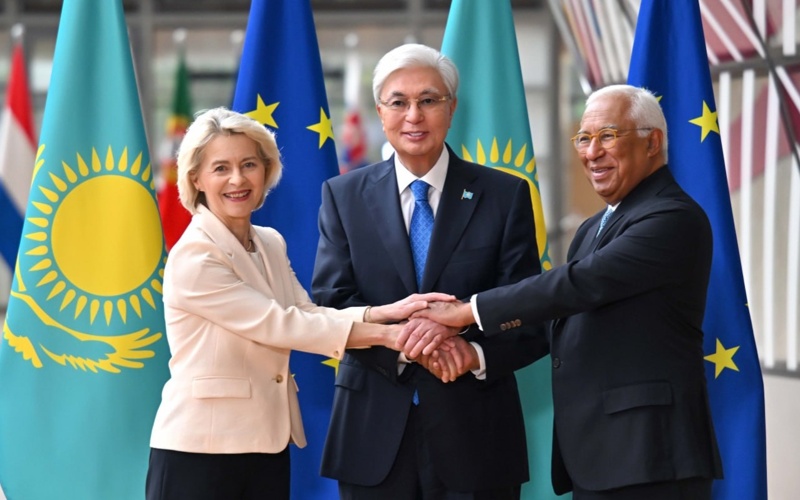
During a packed agenda in the Belgian capital, Tokayev held talks with European Council President António Costa, European Commission President Ursula von der Leyen, Belgian Prime Minister Bart De Wever, senior European officials and representatives of major international financial institutions.
Strategic partnership
António Costa described Kazakhstan as an important bridge between Europe and Asia, highlighting the country's geographic position and growing role in regional connectivity. He noted that the priorities outlined by Tokayev ahead of the visit, namely strengthening resilience, expanding connectivity and creating new opportunities for citizens, align closely with the European Union’s own strategic vision.
Von der Leyen emphasized that bilateral trade has doubled over the decade since the signing of the Enhanced Partnership and Cooperation Agreement and said there remains significant untapped potential for further expansion.
Economic cooperation
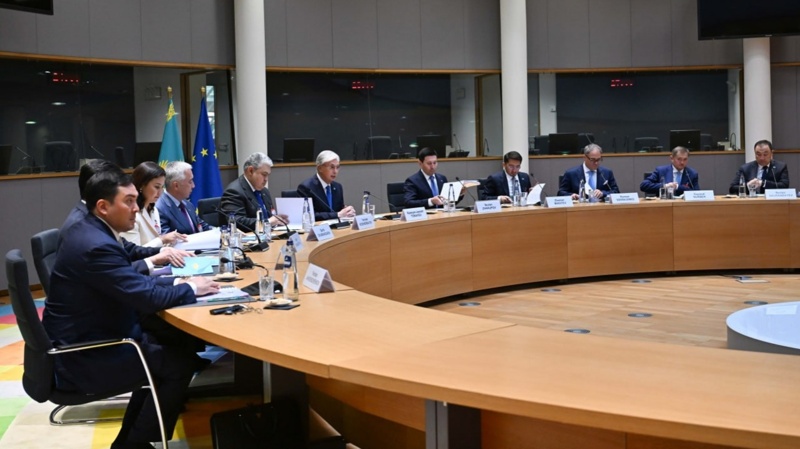
According to the Akorda press service, commercial agreements and memoranda worth more than $12 billion were signed during the trip. Tokayev described the agreements as evidence that European businesses continue to view Kazakhstan as a reliable and attractive destination for investment.
European Commissioner for Trade and Economic Security Maroš Šefčovič called the visit the beginning of a new chapter in EU-Kazakhstan relations, noting that the newly signed agreements are the result of years of efforts to deepen economic cooperation.
Transport corridor becomes a strategic priority
Particular attention was given to the Trans-Caspian International Transport Route, widely known as the Middle Corridor, which has gained increasing significance as governments and businesses seek alternatives to traditional transport routes.
President Tokayev emphasized the importance of linking the Middle Corridor with the EU’s Global Gateway initiative, Brussels’ flagship infrastructure strategy designed to improve connectivity with partner countries.
The joint statement adopted after the talks highlighted the strategic importance of the corridor and welcomed deeper cooperation under Global Gateway.
Among the agreements signed was a memorandum between the European Investment Bank and Kazakhstan’s national road operator KazAvtoZhol to finance road rehabilitation projects along sections of the Trans-Caspian route.
Another agreement with the European Bank for Reconstruction and Development supports the introduction of intelligent transport systems and the development of the E-Zholdary digital platform.
Critical minerals and energy security
The EU and Kazakhstan reaffirmed their commitment to implementing the roadmap under the strategic partnership on sustainable raw materials, batteries and renewable hydrogen value chains.
Critical minerals have become a key priority for Brussels as European governments seek secure supplies needed for clean energy technologies, electric vehicles and advanced manufacturing.
Huseyin Ozhan, EBRD Managing Director for Central Asia and Mongolia, told a Silk Way TV channel correspondent that the bank's newly signed agreements focus on developing a modern critical raw materials laboratory in Kazakhstan and improving transport infrastructure along the Middle Corridor. He said the projects are aimed at strengthening connectivity and supporting the development of sectors where Kazakhstan has significant potential.
The joint statement also highlighted Kazakhstan’s role as a major supplier of oil and uranium to Europe and pointed to opportunities for expanded cooperation in renewable energy and civil nuclear energy.
During talks with Prime Minister Bart De Wever, the two sides reviewed opportunities for cooperation in transport, logistics, critical minerals, petrochemicals, agriculture, manufacturing, digital transformation, artificial intelligence and finance.
The visit also brought new investment commitments in agriculture. Christina Stark, owner and board member of Sweden's Väderstad Group, told a Silk Way TV channel correspondent that the company signed an agreement with local partners to localize the production of agricultural machinery in Kazakhstan. She said the country offers significant opportunities for agricultural investment and remains an attractive market for long-term industrial projects.
Education, science and innovation
Tokayev emphasized Kazakhstan’s interest in expanding participation in European educational and research initiatives, including Erasmus+ and Horizon Europe.
The President expressed hope that Kazakhstan would eventually obtain associated country status within the Horizon Europe framework, which would open new opportunities for scientists, researchers and universities.
The EU and Kazakhstan also agreed to continue supporting academic exchanges, scientific cooperation and people-to-people contacts.
Visa facilitation
A significant development for citizens was the announcement that negotiations on visa facilitation and readmission agreements have been successfully concluded at the negotiators’ level. Both European and Kazakh officials welcomed the progress, describing it as an important step toward strengthening mobility and people-to-people ties.
Kazakhstan’s reforms
The joint statement notes that the European Union recognizes Kazakhstan’s ongoing reform agenda and acknowledges the adoption of a new Constitution through a nationwide referendum earlier this year. European institutions also welcomed continued dialogue on human rights, rule of law and anti-corruption issues.
Speaking to a Silk Way TV channel correspondent, Alberto Turkstra, Political Analyst and Project Director at Diplomatic World, said European observers have closely followed Kazakhstan's political reforms. According to him, the constitutional changes strengthen institutional stability and legal predictability, factors that are particularly important for European investors evaluating long-term opportunities in the country.
Earlier, Qazinform News Agency reported that deals worth over $12 billion were signed during Tokayev’s visit to the EU.