Ancient sanctuary beneath the sands in Kazakhstan sheds light on spiritual world of nomads
Hidden in the vast Ustyurt steppe of West Kazakhstan lies Bayte-3, a mysterious sanctuary dating back to the 4th-3rd centuries BC. Buried for centuries beneath sand and largely concealed from view, the ancient structure offers a rare glimpse into the spiritual beliefs and worldview of early nomadic peoples, Qazinform News Agency reports.

Located about 20 kilometers northeast of the village of Sai-Otes in Mangistau region, the site was investigated in 1998 by the West Kazakhstan archaeological expedition.
Archaeologists uncovered the remains of a monumental sanctuary, numerous stone sculptures, and artifacts linked to the cosmological, animalistic, and calendrical concepts of ancient nomads. The findings suggest that Bayte-3 was far more than a simple building. It is considered one of the most important archaeological sites for studying how people of that era understood nature, the heavens, and the passage of time.
The sanctuary's design is unique. The structure measures about 19 meters in diameter, with some interior walls preserved to a height of three meters. Its outer walls were constructed from carefully shaped stone blocks, and researchers estimate the original building stood more than five meters high.
The sanctuary consisted of a two-tier system featuring a cylindrical base topped by a dome. The main structure stood on a foundation approximately 14 meters in diameter and was enclosed by an outer wall about 2.5 meters thick, built from stone and earth.
The internal layout forms a cross-shaped plan aligned with the four cardinal directions. At the center stood a stone altar, where fires may have been lit and sacrificial rituals performed.
A stone staircase, of which 14 steps survive today, led down into the central hall from a height of roughly 2.5 meters. The builders employed a corbelled vault technique, creating a false dome above the sanctuary. At its apex was a large opening that served as a skylight. Scholars believe the dome may have reached a height of about 10 meters.
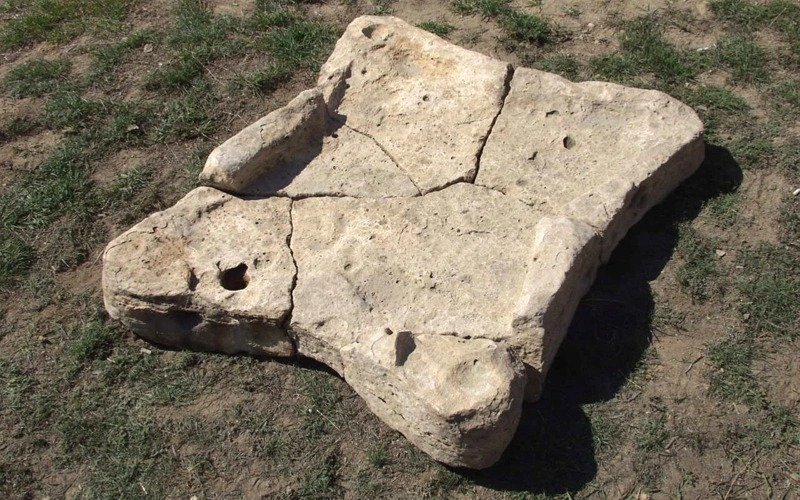
Unlike settlements, Bayte-type sanctuaries contain very little evidence of everyday life. Archaeologists found few household remains and no signs of permanent habitation. Instead, only occasional ritual objects, small stone vessels, and fragments of altars were discovered, reinforcing the belief that these complexes served exclusively religious functions.
The interior and exterior walls of Bayte-3 bear numerous tamgas and engraved symbols. While their exact dates remain uncertain, researchers believe many may belong to the Alan period.
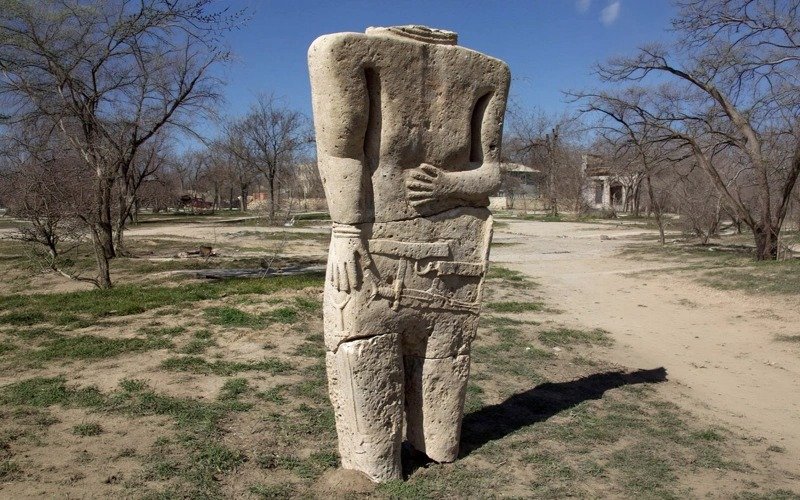
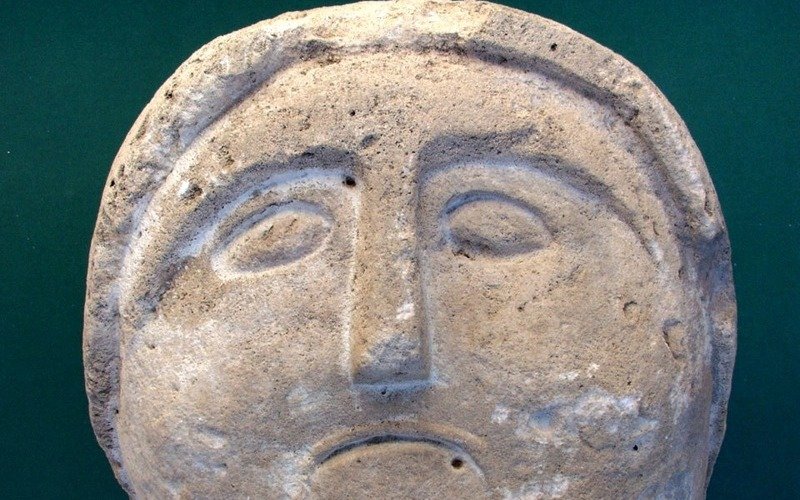
Particularly intriguing are the anthropomorphic stone statues found near the sanctuary. These sculptures differ from those of both the earlier Saka period and later eras, suggesting that the Ustyurt-Mangistau region developed its own artistic and architectural traditions during the Early Iron Age.
Researchers associate Bayte-type sanctuaries with the culture of the Sarmatian tribes that inhabited the lands between the Aral and Caspian seas. During this period, tribal culture flourished, and political and military influence expanded across the region.
The placement of major sanctuaries such as Bayte and Kyzyl-Uik indicates they may have served as important ceremonial centers for tribal confederations. Stone statues depicting armed warriors also point to the distinctive character of the era.
According to scholars, Bayte-3 was likely destroyed by a powerful earthquake. Over time, some of its stones were reused elsewhere, while the remaining ruins were gradually buried under sand, forming a mound-like hill.
The site remained hidden for centuries until archaeological investigations brought it back to light. In 2003, Bayte-3 was placed under state protection as a historical and cultural monument of local significance.
Aiman Yarikhanova, head of a department at the Mangistau State Historical and Cultural Reserve, notes that monuments such as Bayte-3 help researchers understand not only the daily life of ancient nomads but also their perception of the natural world, the heavens, time, and existence itself.
Today, Bayte-3 stands as one of the most valuable monuments of the ancient nomadic civilizations of Mangistau and the wider Eurasian steppe.
Earlier reports highlighted, Bronze Age settlement unearthed in N Kazakhstan.