Serbia and Kazakhstan set ambitious new cooperation agenda - Aleksandar Vučić
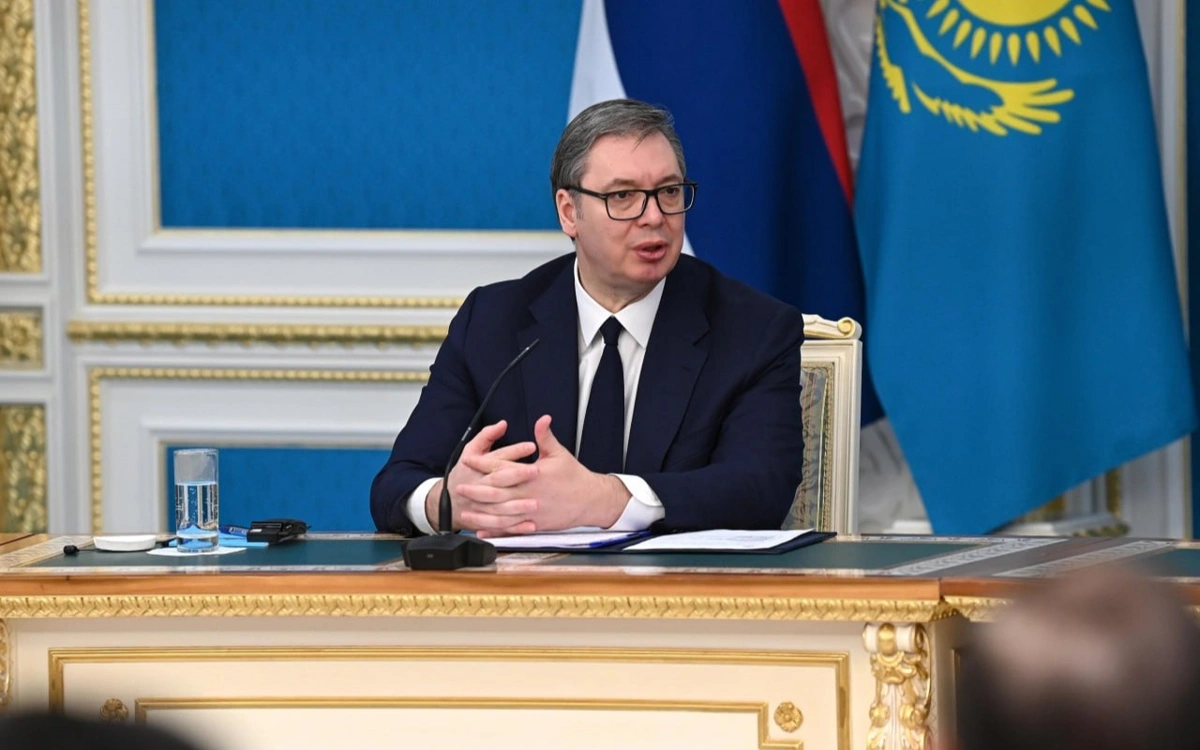
As part of his official visit to Kazakhstan, Aleksandar Vučić, President of the Republic of Serbia, sat down with Silk Way TV Channel to discuss the outcomes of the trip and the prospects for deepening bilateral cooperation. In an exclusive interview, he addressed the development of logistical routes, food security, and the strengthening of cultural and diplomatic ties, outlining his vision for the future of Serbia-Kazakhstan relations.
Mr. President, you know Kazakhstan well. You have visited our country numerous times. In 2024, a first official visit of the President of Kazakhstan to Serbia took place - that visit both you and President Tokayev described as a new chapter to relations. Could you please share some of the tangible outcomes that have emerged from those negotiations that took place in Belgrade?
I believe that his visit to Belgrade was a really historical, essential, substantive one. I believe that since then we started developing different projects and the prospect of our cooperation looks much better today than it used to be the case before. I was honored by President Tokaev and by our Kazakhstan hosts with the SU-30 that accompanied my plane. That's a great honor for my country, for myself.
The level of hospitality in Kazakhstan is well known all over the world. But this is just the beginning of our cooperation. I hope and believe that President Kassym-Jomart Tokayev as one of the biggest leaders of the world, as someone who speaks to all different parties and factions on the globe, I can say that he is not only well known, but well accepted by everybody, which is very difficult in having multivectoral approach in foreign policy and keeping this relationship.
During his visit to our country, we opened several fields of possible cooperation. One is AI, digitalization, and the IT sector. Another one is trade exchange based on agricultural products. Another one is military technical cooperation and transfer of technology of some military industry companies, which we have already signed or we are about to sign.
But more importantly, I believe that we'll be able to bring more of Kazakhstan's people to Serbia in order to boost our trade exchange, which is around USD 120 million today. And it has to be our main goal (to achieve-edit.) USD one billion. And I'm certain that within five years, we can reach that level.
You have outlined the main priorities of bilateral cooperation and also the agenda of your current visit.
It's many. We hope that Kazakhstan will build its center in Belgrade and many other stuff.
Turning to logistics. This is a very big and important topic, particularly discussing the Transcaspian international transport route, widely known as the Middle Corridor. My question here is how does Serbia see its role being a major industrial and logistics hub itself in the Balkans within this global supply chain?
It's becoming more and more important for us because if you analyze it, if you were asking me this question three or four years ago, I would have not been able to say almost anything about it. Now I know exactly which dots, which points, which cities you were able to reach in China from NanJing, X’ian, and all the others. And then finishing at the Caspian Sea in Kurik and Aktau. And then going through both, Turkiye, Azerbaijan, Georgia, to Sofia or to Black Sea - to Constance and Bucharest, then we are very much connected with both, and we have to deliver on building up our logistics on that.
But having in mind the fact that China is, I believe, number one trade partner of Kazakhstan, it'll become in two or three years number one trade partner with Serbia. These logistic ties are becoming more and more important, and we're going to use them more and more. I see what President Tokaev is doing in a very smart way. He's monetizing these routes and shortening the path, building these highways, shortening the path for, let's say, 900 kilometers, as I saw in his plans. This is huge.
This is of utmost importance for everybody that will have to cooperate and collaborate with China, Kazakhstan and entire Central Asia. And I believe that President Tokayev and Kazakhstan are on a very right path and we'll follow it, and we'll build our logistics in order to get closer to an entire route.
What joint industrial projects between Astana and Belgrade could emerge in the nearest future in this field?
I'll discuss it today with President Tokayev, because I came here with a lot of ideas.
Can we say that Serbia can possibly become the main gate for Kazakhstan's goods and resources for South Eastern Europe?
Hopefully, yes. There were some issues because of our national airline and our national carrier about fifth freedom, whether you'll be able with your airline as private or state-owned to fly towards some other destinations, not only to Belgrade. If there is a country that will get it right, that is going to be Kazakhstan.
We have already launched the direct flight. It's also helpful.
Yes, twice a week.
Let us talk about food security. Food security is increasingly viewed as a matter of national security. Kazakhstan obviously has vast natural resources, while Serbia brings advanced agricultural technologies to the table.
You have a lot of resources and you buy some seeds, special seeds from us, and you can buy some more agricultural products from us, and we can buy much more from you. This is something that we should work on. This is why we need to bring your trade guys, sales guys to Serbia, and to see how we can improve our collaboration on this issue. Also, it's about the use of satellites, biotechnologies, and AI in the agricultural industry, particularly the agricultural processing industry. I believe that we can work very much jointly in all this stuff.
Is the time right to move towards creating an agritechnology cluster?
Yes.
And what should be the procedural steps to launch this ambitious goal?
I don't care about procedural steps because I believe that we can resolve it much easier than with many other countries. I think when people want to arrange something, when they want to agree upon something, they can easily do it. President Tokayev, I was reading carefully his speech very recently given to the public here in Kazakhstan, was insisting on water resources of Kazakhstan, which shows to me, because you mentioned food, not only as a topic for trade, but the main topic of keeping sovereignty of the nations. It's the same with water resources.
It shows to me how responsible President Tokayev is towards his people, and he recognizes what is going to be one of the most important issues for the next decades. Apart from AI, new technologies, it's water and food. We'll focus ourselves, and of course, the military industry, somewhere in the middle. This is something that we're going to focus our cooperation on in the future.
Let’s talk a little bit more about trade. You mentioned that trade turnover between two countriesstill doesn't show a full potential of partnership. But in terms of this year, what do you think, what will be the sectors that will potentially show the dynamics of growth?
I expect more next year to happen. But we need to do a lot of preparations for that.
Which sectors will become the main drivers of growth?
All sectors. That's the numbers that I have already mentioned. We need to make big progress in all different sectors. Speaking about military technical cooperation, transfer of technology, speaking about agriculture, speaking about energy issues as well. We can work together. We can be both, President Tokayev, and myself, we have great friends in the Gulf, particularly people from the United Arab Emirates. They have some sovereign funds.
We can jointly work on different issues, which I will propose to the President today and to the President of the United Arab Emirates as well. I'm a bit envious of my friend, President Tokayev, and I know that because he's a very responsible and very serious man, he's never satisfied with his results. But I see that you're ahead of us in educating your young people abroad, bringing foreign universities and faculties here, and we would like to be a part of that.
You just said that Serbia has very good results in digitalization and AI. You have the Center for the Fourth Industrial Revolution under the World Economic Forum, for example.
Agricultural products participated in our overall GDP just 10-12 years ago, about 10 - 11%. Now, it's 4%. We used to be a well-known agricultural country. The IT sector was participating with 3.5%. Today, it's 13% of our overall GDP. That's a huge change. It means that we caught our pace with the Fourth Revolution, at least.
Now, there are new revolutions which are lasting shorter and shorter, but with a bigger impact. AI will change the world. I'm not sure that anyone in the world is ready for that. Not even Americans and Chinese, which are the most ready countries and nations.
There is a big AI race which is happening right now.
It's neck to neck between China and the US, but all the others, we are lagging behind. But the real issue is how much we're going to be lagging behind. Kazakhstan is doing a great job, and we are doing something, and I'm still not happy. That's the sphere in which we can cooperate much more, combining our efforts.
Complimenting each other's efforts, probably, in a way that we can build a very sustainable infrastructure, for example.
Speaking about data centers, supercomputers. And I noticed also that President Tokayev mentioned that in his speech, it's a real power supply and it's going to be very difficult. It's not easy at all.
You're a country which has a lot of gas, a lot of oil, and everything else, but it's not going to be easy to supply everything that is necessary in a time of AI, electric vehicles, because an entire electric grid has to consume it easily, which is more problematic than anything else we were facing in the past.
We know that you will visit the international AI center here in Astana.
Yes, I'm eager and cravingly waiting for that.
Let’s move on now to cooperation between Serbia and Kazakhstan on the international stage. Serbia is an upper middle income country. Kazakhstan is increasingly described as a responsible middle power. How would you characterize its role in regional and global affairs?
President: I'll be very brief on this. I can always in advance sign everything that Kazakhstan might sign, which means that we have the same interest, which is observance of the UN charter, the UN resolution. We supported the territorial integrity and sovereignty of Kazakhstan. We have always had all kinds of support from Kazakhstan regarding territorial integrity and sovereignty of Serbia, and I'm sure that it will remain so. It's a great cooperation.
We believe in each other and we believe that we are pretty much in the same position in today's very volatile world, a world that is facing real erosion of international public law and a pretty much chaotic world.
How do you position, strategically, Serbia's engagement with Kazakhstan within this very challenging geopolitical context?
We have multivectoral politics, both of us. Your president is very smart, taking care of your very best interests and cooperation with China, with the European Union, increasing the level of trade, cooperation, economic and political ties with the European Union, with the United States of America - very recently, bold and big steps forward. With Russia - keeping traditional ties and good friendship. This is the politics that we also conduct. I really admire your president and your top political leadership in not only advocating, but conducting and providing and implementing this multivectoral politics.
To wrap up, we have a street named after the great Nikola Tesla in Astana. We know that there is an alley of Kazakh-Serbian Friendship in Belgrade. What other symbols of cultural rapprochement between the two nations could emerge in the future?
I believe that we should learn more about Kazakhstan's history. That's why President Tokayev wanted to build Kazakhstan’s National Cultural Center in Belgrade, and we're going to provide all the licenses, the plots, and everything else for that. That is very necessary. Actually, I can tell you one more thing. You know that the Red Army, together with our partisan units, liberated Serbia in the Second World War. But for the first time, we heard there were significant participants of Kazakhstan units liberating Belgrade within the Red Army. We started now learning history from a bit of a different angle, and scrutinizing your history and your culture.
And I think that you can see why we are very close to each other today, because of many historical moments that we had as a common denominator, as a part of shared history all over this big distance. And I believe that improving our ties, increasing the level of our ties, and I will do my best to bring President Tokayev as soon as possible to Serbia, I believe that we'll do a lot. We have a bright future.
Earlier, Qaziform News Agency reported Kazakh President Kassym-Jomart Tokayev and Serbian President Aleksandar Vučić held extended talks at the Akorda presidential palace in Astana. The high-level talks are set to focus on strengthening the political dialogue, expanding trade and economic ties, and cultural-humanitarian cooperation.