Scientists map 3D ground deformation across Almaty
A new study has provided the first three-dimensional assessment of ground deformation across Almaty and surrounding areas, based on seven years of satellite observations validated with ground measurements, Qazinform News Agency reports.
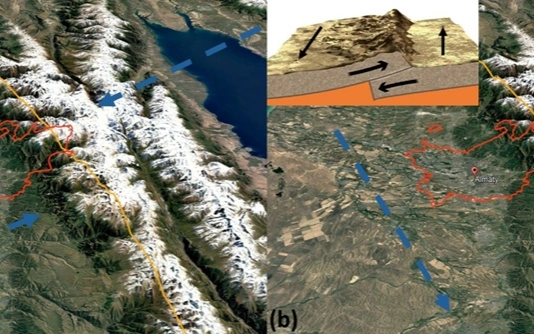
Published in Advances in Space Research, the study was led by Dr. Emil Bayramov, Associate Professor in the Department of Mining and Geosciences at Nazarbayev University’s School of Engineering, in collaboration with the Institute of Ionosphere.
The research found a complex pattern of uplift, subsidence and horizontal movement. Annual vertical deformation ranged from −95 millimeters of subsidence to +52 millimeters of uplift. East-west movement ranged from 156 millimeters westward to 211 millimeters eastward, while north-south movement ranged from 20 millimeters southward to 19 millimeters northward.
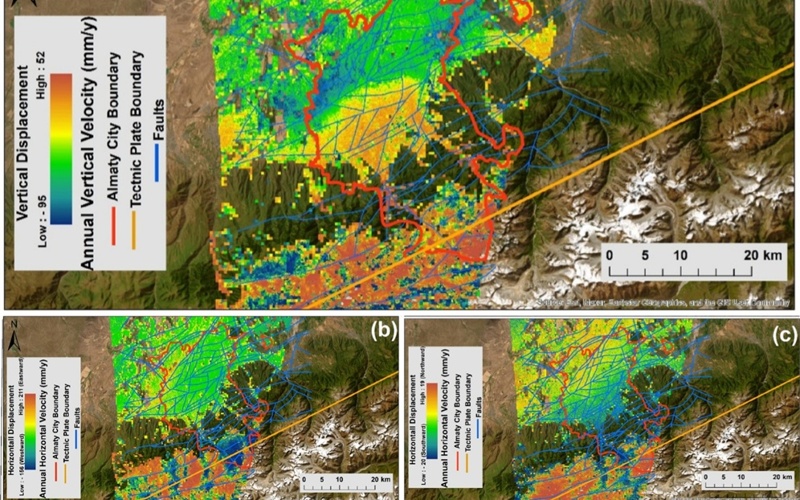
A key finding was a pronounced transition zone in central Almaty, where uplift in the south changes to subsidence toward the north. The zone closely follows the Central Almaty Fault, which showed the clearest fault-related deformation pattern identified in the study.
Researchers said the observed movements likely reflect a combination of natural geological processes and human activity. Satellite data were validated using GPS measurements and documented cases of landslides, building deformation, cracking and bridge deformation.
The findings could support infrastructure monitoring, geological, geotechnical and seismic risk assessment, and urban planning. However, the study does not establish that all ground movements are linked to active faults and is not intended to predict earthquakes.
Similar satellite-based assessments are now being conducted for Astana and coastal cities around the Caspian Sea, with the aim of supporting urban safety, infrastructure monitoring and risk assessment.
Earlier, Qazinform News Agency reported that the Kazakh government allocated 40.7 billion tenge from its reserve for geological mapping and seismic surveys.