

New comic book links Central Asia and U.S. history at Astana launch
The American Corner in Astana hosted the official presentation of The Long Journey to Liberty, a new graphic novel created to mark the 250th anniversary of United States independence and highlight historical and cultural connections between Central Asia and North America, reports a Qazinform News Agency correspondent.

The comic book project, supported by the U.S. Embassy in Kazakhstan, combines history, indigenous heritage, and democratic values through a visual narrative divided into three chapters: “The Ancient Journey,” “Seeds of Democracy,” and “Inspiring America’s Founders and First Diplomat.”
Cale Wagner, Public Diplomacy Officer at the U.S. Embassy in Kazakhstan, said the project was designed to tell a story connecting Central Asia with Native Americans and the foundations of the United States.
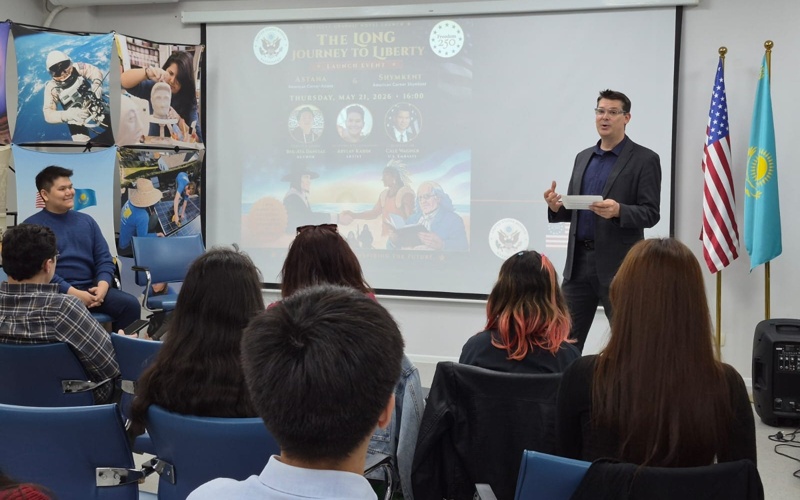
“What is really exciting about this comic book project is that our artists and our author took their talents to tell a story that connects Central Asia to the indigenous people of North America, which shows also how they influenced the Founding Fathers of the United States,” Wagner said.
He noted that the story reflects shared heritage and cultural parallels between Central Asian and Native American communities.
“If Africa is the cradle, then Central Asia is the nursery,” Wagner said, recalling a documentary about early human migration and the movement of ancient peoples through Central Asia to North America.
According to the creators, the first chapter of the graphic novel focuses on the migration of ancient tribes across the Bering Land Bridge.
Author Bek-Ata Daniyal explained that the story emphasizes themes of mutual assistance, perseverance, and reconciliation.
“They migrated through freezing weather, through thirst, and they brought with them mutual assistance,” Daniyal said. “This is how ancient tribes of Central Asia and Native Americans are connected.”
The second chapter explores the relationship between early European settlers and the Wampanoag people, while the final section examines how Native American governance systems, particularly the Iroquois Confederacy, influenced democratic thought among America’s Founding Fathers.
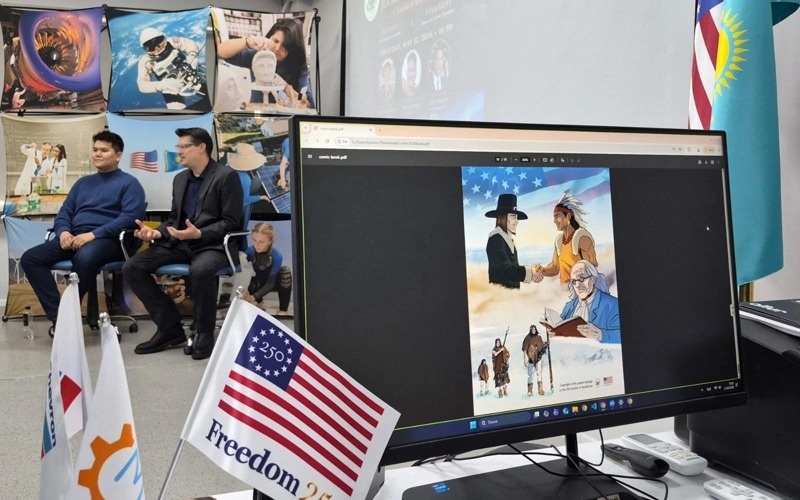
Artist Abylay Karin said he drew inspiration from Marvel and DC comics, as well as historical video games such as Assassin’s Creed, to recreate different historical periods and atmospheres in the graphic novel.
“The first part was mostly in cold colors, but at the end it changed to warmer colors,” Karin said, describing the visual transition between the comic’s eras. He added that one of his favorite scenes was the final page of the first chapter, which symbolizes “the beginning of a new time, and the warmth, and the happiness” for the migrating tribes.
Karin said he aimed to give each chapter a distinct visual identity through color palettes and design elements reflecting different historical settings, from the icy landscapes of the Bering migration to the colonial and diplomatic eras of early America.
Karin also shared his views on artificial intelligence in art, saying AI remains limited for professional comic book and animation work.
“Every detail is essential,” he said. “AI doesn’t have this thinking ability. It just copies and makes something similar to the original.”
Earlier, Qazinform News Agency reported that a copy of Superman #1 discovered in a northern California attic became the most expensive comic book ever sold after fetching $9.12 million at a Heritage Auctions sale.