

Japan’s baby bust has created a nation of “fur babies”
Japan is home to around 15.67 million pet cats and dogs, nearly 2.4 million more than the number of children under 15, Qazinform News Agency reports.

According to the Japan Pet Food Association’s 2025 national survey, the country had an estimated 8.85 million cats and 6.82 million dogs. Together, their population stood at approximately 15.67 million.
Meanwhile, the Statistics Bureau of Japan estimated that the number of children under 15 had fallen to 13.29 million as of April 1, 2026.
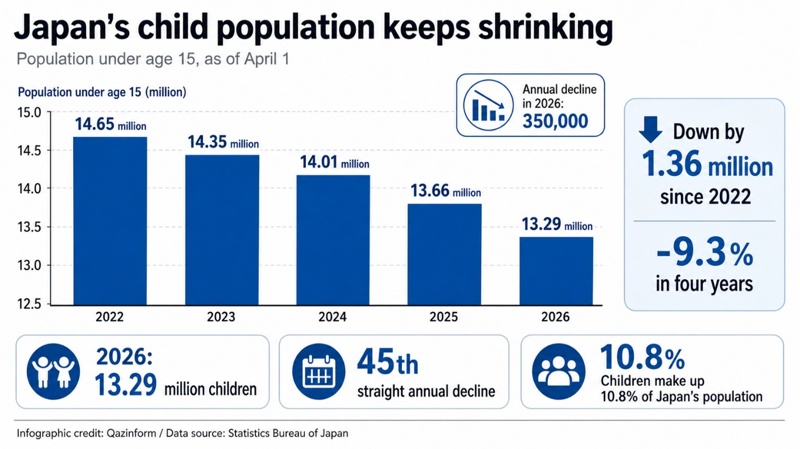
The child population decreased by 350,000 from the previous year, reaching the lowest level on record. It marked the 45th consecutive annual decline since 1982. The country had approximately 6.81 million boys and 6.48 million girls, with boys outnumbering girls by around 330,000.
Children accounted for just 10.8% of Japan’s total population, down 0.3 percentage points from the previous year. The proportion has now fallen for 52 consecutive years since 1975.
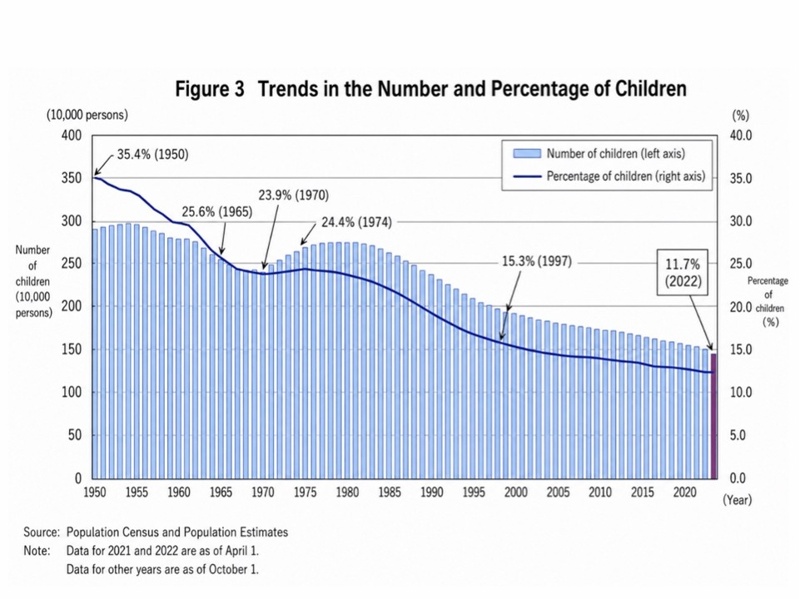
For comparison, children made up 35.4% of Japan’s population in 1950. The share declined to 23.9% by 1970, briefly rising to 24.4% in 1974 during the country’s second baby boom before resuming its long-term fall.
However, the growing gap between pets and children is not the result of a rapid increase in Japan’s overall pet population alone.
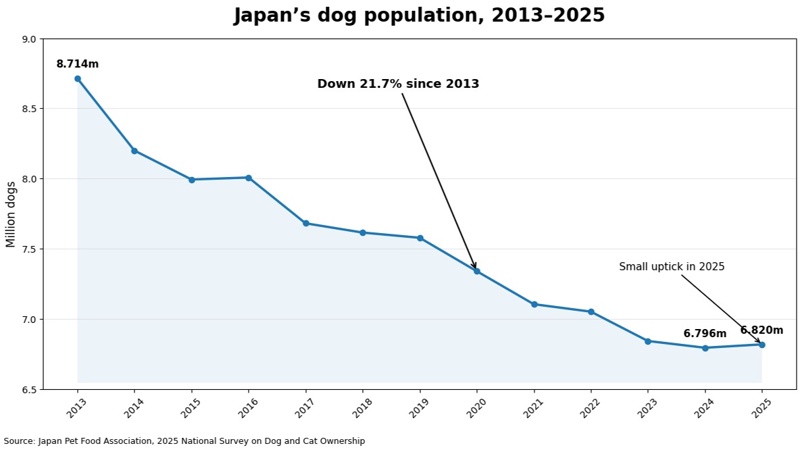
The number of dogs declined from around 8.71 million in 2013 to 6.82 million in 2025.
Over the same period, the cat population increased more moderately, from approximately 8.41 million to 8.85 million.
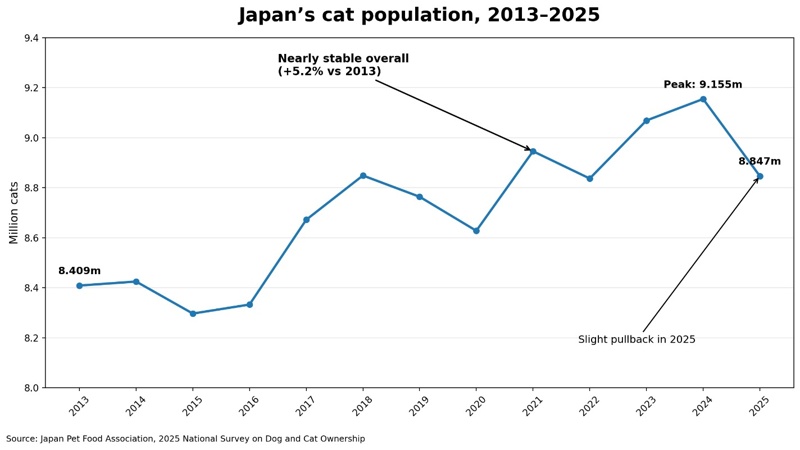
Taken together, Japan had around 17.12 million cats and dogs in 2013, meaning the total pet population was actually about 1.46 million higher than in 2025. The comparison therefore largely reflects the continued decline in the number of children rather than a surge in pet ownership.
The survey also showed that the average number of animals per pet-owning household had increased. In 2025, dog-owning households kept an average of 1.36 dogs, up from 1.24 in 2013, while cat-owning households had an average of 1.78 cats, compared with 1.71 in 2013.
At the same time, interest in acquiring a new pet has weakened. Among people who did not own a pet, the share considering getting a dog fell from 8.9% in 2021 to 6.7% in 2025. For cats, the figure declined from 6.5% to 5% over the same period.
Despite the decline in pet numbers and prospective owners, spending on animals continues to increase.
According to Euromonitor data cited by Al Jazeera, Japan’s pet care market was valued at 880 billion yen, or about $5.4 billion, in 2025, up from 689.6 billion yen in 2020. This represents growth of nearly 28% in five years.
Euromonitor said the market continued to grow in value terms in 2025, partly due to higher pet food prices. Demand for premium products, particularly cat food focused on health and quality, is also expected to support further market growth.
The Japan Pet Food Association’s survey put average annual spending at 192,356 yen for a dog and 119,972 yen for a cat, equivalent to monthly averages of approximately 16,030 yen and 9,998 yen, respectively.
The shift has encouraged companies traditionally associated with children’s products to target pet owners. Japanese baby carrier manufacturer Lucky Industries has introduced carriers designed for dogs, while personal care company Unicharm has expanded its range of pet diapers and other products.

Unicharm’s pet care division recorded a core operating income margin of 15.4% in 2025, compared with 10.7% for its personal care business. Pet products accounted for 17% of the company’s total sales, with the share expected to rise to 20% by 2030.
The expansion reflects the growing “humanization” of pets, with owners increasingly treating cats and dogs as family members and spending on premium food, healthcare, clothing, carriers, strollers and other specialized products.
Earlier, Qazinform News Agency reported that 477 Japanese municipalities lost more than 10% of their population between 2020 and 2025, highlighting the growing impact of demographic decline on local communities.