AI on the tarmac: IATA to bring global aviation leaders to Cairo for ground operations rethink
The International Air Transport Association will hold the 38th IATA Ground Handling Conference (IGHC) in Cairo, Egypt, from May 19-21, 2026, bringing together industry leaders to address the future of ground operations, Qazinform News Agency correspondent reports.

The event will focus on the theme “Adapting Ground Operations in an Era of AI.” The conference will examine how human expertise, supported by artificial intelligence and automation, will shape safer, more efficient, and more resilient ground operations.
Earlier it was reported that IATA had updated its dangerous goods regulations for air travelers, maintaining restrictions on a range of items while allowing some personal belongings under specific conditions.
The 67th edition of IATA’s Dangerous Goods Regulations, which came into effect on January 1, 2026, stated that dangerous goods remained prohibited in checked and carry-on baggage unless they were expressly listed as permitted. The rules covered a wide range of items carried by passengers and crew, from alcoholic beverages and aerosols to medical equipment, batteries, and electronic devices.
Among the items still allowed under specified limits were alcoholic beverages in retail packaging containing more than 24% but not more than 70% alcohol by volume, with a maximum of 5 liters per person, as well as certain medicinal and toiletry articles, including aerosols, within prescribed quantity caps.
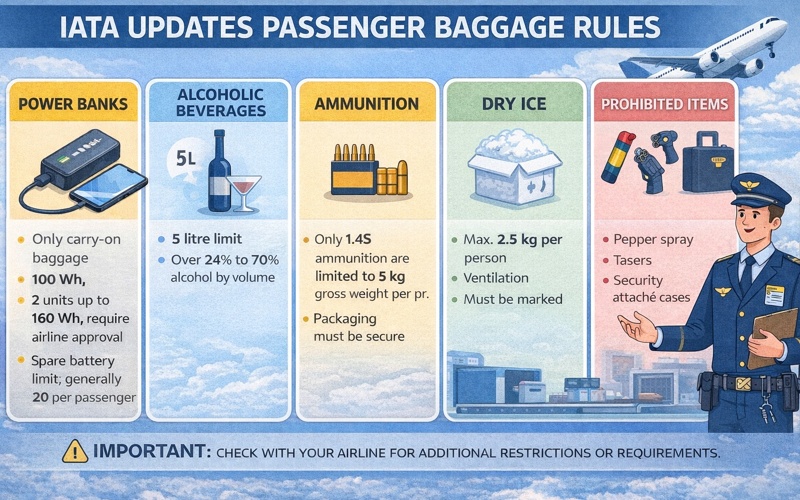
A notable part of the updated guidance concerned batteries, especially portable backup chargers widely used by travelers. Under the regulations, power banks were treated not as regular accessories but as spare batteries. That meant they had to be carried in cabin baggage only and could not be packed in checked luggage.
IATA said spare or loose batteries for portable electronic devices had to be individually protected against short circuit. For lithium-ion batteries, including most standard power banks, the watt-hour rating had to not exceed 100 Wh. The rules also set a general limit of 20 spare batteries per passenger, though airlines could approve more.
Larger spare lithium batteries with a rating above 100 Wh but not above 160 Wh were subject to tighter limits. They were allowed only with airline approval, only in carry-on baggage, and only up to two per passenger.
The regulations distinguished these spare batteries from electronic devices with batteries already installed. Phones, tablets, laptops, cameras, and some medical devices could be transported under separate conditions, but any such device placed in checked baggage had to be completely switched off and protected from accidental activation or damage.
The document also listed items that remained fully prohibited, including disabling devices such as pepper spray and electroshock weapons such as Tasers. It added that airline and state-level rules could impose additional restrictions beyond the general IATA framework.
Earlier, Qazinform News Agency reported that IATA had launched Travel Smart with Lithium Batteries, a global campaign designed to provide travelers with simple guidance on reducing safety risks linked to improperly carried devices.