6G will connect intelligence, says AI expert Merouane Debbah
As Kazakhstan works to expand the use of artificial intelligence across its economy, Prof. Merouane Debbah sees an opportunity for the country to develop solutions rooted in its strengths, from industry and agriculture to connectivity across its vast territory. In an exclusive interview with Qazinform News Agency, Debbah discusses how AI and 6G could shape daily life, what it takes to turn research into products, and where Kazakhstan could compete internationally.

Prof. Merouane Debbah is an international expert in artificial intelligence and 6G technologies, Founder and Senior Director of the AI and 6G Research Center at Khalifa University in the UAE, and a member of the Expert Council on Artificial Intelligence Development under the President of the Republic of Kazakhstan.
Artificial intelligence is already being actively integrated into all areas of our lives. You also research the interaction between AI and next-generation communication networks. In your view, what will everyday life look like in the future when artificial intelligence and 6G infrastructure become an integral part of society?
I believe the biggest change will be that artificial intelligence will gradually disappear as a separate “application.” Today, we consciously open ChatGPT or another AI service when we want assistance. In the future, intelligence will become an ambient layer embedded in our phones, cars, homes, factories, cities and communication networks. This is where 6G becomes very important. I often say that 6G will not simply connect devices; it will connect intelligence. The network will no longer be only a pipe that transports information. It will increasingly sense the environment, understand what is happening, allocate computing resources, coordinate AI agents and react in real time.
Imagine travelling to another country and communicating naturally with anyone because translation is instantaneous. Imagine a vehicle exchanging information not only with other vehicles but with roads, traffic infrastructure and nearby sensors. In healthcare, wearable devices could continuously interact with intelligent systems to detect anomalies much earlier. In education, every student could have access to a personalized AI tutor. In industry, machines, robots and networks could collectively anticipate failures before they happen.
The important technological transition is therefore from a network of connected devices to a network of connected intelligence. This is already reflected in the international vision for 6G. The ITU's IMT-2030 framework includes not only faster communications, but ubiquitous connectivity, AI integrated with communications, and integrated sensing and communications.
But there is another side to this transformation. When intelligence becomes embedded everywhere, cybersecurity, privacy, resilience and trust become even more important. A truly successful AI and 6G society will therefore not be the one with the largest number of algorithms. It will be the one that manages to make intelligence useful, accessible, secure and trusted.

You are a member of the Expert Council on Artificial Intelligence Development under the President of Kazakhstan. Which areas of AI development in Kazakhstan deserve the greatest attention at this stage? And in which sectors could Kazakhstan develop its own solutions capable of reaching international markets?
For Kazakhstan, I believe the next stage should be about moving from AI consumption to AI creation, and from AI experimentation to AI production. There are three foundations from my point of view:
The first is human capital. Ultimately, countries do not compete through GPUs; they compete through people who know what to do with them. Kazakhstan needs researchers, engineers, entrepreneurs and, equally importantly, specialists in traditional industries who understand how to apply AI to real problems.
The second is infrastructure: computing capacity, high-quality data, national models and platforms that researchers, startups, universities and companies can actually access. Kazakhstan has already made significant progress here through national computing infrastructure, Alem.ai and national AI models.
The third, and in my view the most important now, is industrial AI. Kazakhstan does not need to reproduce everything being developed in Silicon Valley or China. It should ask a different question: Where does Kazakhstan possess data, expertise, infrastructure or industrial problems that few other countries possess at the same scale?
Mining and metallurgy are obvious examples. AI can be used for predictive maintenance, autonomous operations, geological modelling, safety, optimization of energy use and digital twins of industrial assets.
Energy is another major opportunity. AI will increasingly manage generation, demand, grids and complex energy systems. Kazakhstan's Ministry of Energy is already developing a transformation strategy around AI and digital twins.
Agriculture is particularly interesting because Kazakhstan's scale creates problems that cannot always be solved using approaches developed for small, densely populated countries. Satellite imagery, autonomous machinery, weather prediction, water optimization and precision agriculture could become areas where Kazakhstan develops solutions that are relevant far beyond its borders.
Then there is logistics. Kazakhstan's geography between Europe and Asia makes intelligent logistics, multimodal transportation, railway optimization and digital corridors particularly relevant.
And finally, Kazakhstan has an opportunity around multilingual and culturally aware AI, including Kazakh-language technologies. Languages with fewer digital resources will increasingly require their own datasets, models and speech technologies.
The objective now should be to move further up the value chain: from exporting software services to exporting intellectual property, AI platforms and industry-specific AI products.
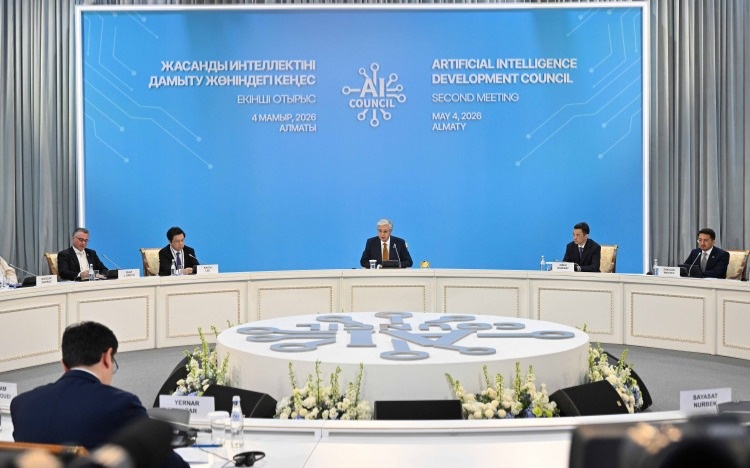
At the second meeting of the Expert Council on Artificial Intelligence Development in May, President Kassym-Jomart Tokayev emphasized the need to move from pilot AI projects to large-scale implementation across the economy, strengthen the link between research and the market, and develop practical AI solutions for key sectors such as industry, energy, agriculture, and logistics. As a member of the Council, what specific steps have you and your colleagues taken since that meeting to implement the President's directives? Which initiatives are currently underway, and what tangible results can we expect in the near future?
I would first make an important distinction. The Council is an advisory and strategic body. Its role is to bring together government, industry, academia and international experts, identify priorities and help shape the direction. Implementation itself is carried out by ministries, universities, national companies, startups and industry.
At the second Council meeting on May 4, 2026, the discussion was very clearly moving from AI as a technological topic toward AI as an economic productivity instrument. Mining and metallurgy, energy, agriculture and logistics were specifically identified as priority areas, together with digital twins, industrial data and automation. I also had the opportunity to contribute to that discussion.
My own emphasis has consistently been on three things.
First, we should move from generic AI to AI+X: AI combined with energy, telecommunications, manufacturing, agriculture, finance, education or government. The real economic value will not come simply from building another general-purpose chatbot. It will come from systems that understand the physics, data, constraints and workflows of a particular industry.
Second, we need to close the gap between the laboratory and deployment. A research paper, a benchmark or a prototype is only the beginning. We need mechanisms through which universities work on real industrial datasets, companies fund long-term research, startups can commercialize intellectual property, and successful prototypes can be deployed at national scale.
Third, I strongly believe that Kazakhstan should combine sovereign capability with international openness. These are not contradictory. A country should have the capacity to understand, adapt and operate critical AI technologies itself while collaborating with the best researchers and companies globally.
What is encouraging is that several concrete elements of this ecosystem are now moving from plans into operation.
Qazaq AI Research University began its first academic year on September 1. As of September 18, the Government reported 525 learners, including bachelor's and master's students and executives, with programs built around the AI+X model in areas including energy, medicine, finance, government and industrial systems. Research structures are being created around core AI, robotics and applied AI.
The AI-Sana initiative has already provided advanced AI training to more than 100,000 students, while hundreds of student-developed AI solutions are moving into testing and implementation.
At the infrastructure level, Kazakhstan is also scaling computing capacity. The Data Center Valley initiative in Ekibastuz is being developed as a major AI-computing hub, with agreements covering substantial new GPU and data-center capacity.
For me, however, the real test over the coming years should not be the number of AI demonstrations or even the number of models created. We should measure productivity generated, costs reduced, exports created, scientific results commercialized and Kazakhstani companies reaching international markets.
That is when AI becomes an economic transformation rather than simply a technology program.
6G is often described as the next stage in the evolution of mobile communications. Which capabilities of 6G do you consider the most promising in terms of their real-world impact on the economy and society? And which of these could be particularly relevant for Kazakhstan, given its vast territory, remote regions, and need for digital infrastructure?
I would first challenge the idea that the main purpose of 6G is to make smartphones faster. Faster communication will certainly come, but economically it may not even be the most important part.
Three developments are particularly significant.
The first is ubiquitous connectivity. Future networks will increasingly integrate terrestrial mobile networks, satellites, aerial platforms and other communication systems. For a geographically vast country such as Kazakhstan, this is extremely important. Kazakhstan is already demonstrating why such an architecture matters.
Hundreds of remote villages have been connected using satellite systems where conventional terrestrial deployment is economically difficult, and the national connectivity program continues to combine fibre, mobile and satellite infrastructure. 6G should take this much further: instead of treating satellite and terrestrial networks as separate worlds, they can increasingly become one integrated connectivity fabric.
The second transformation is integrated sensing and communication. A future base station will not only transmit data. The radio signals themselves can potentially be used to detect objects, estimate location, map environments or monitor movement. The ITU explicitly includes integrated sensing and communication as one of the new IMT-2030 usage scenarios. For Kazakhstan, this could become relevant for agriculture, mining, transportation, railways, pipelines, infrastructure monitoring and emergency response across large geographic areas.
The third is AI-native networking. Today's networks use AI as an additional optimization tool. In future networks, AI will increasingly be part of the architecture itself. Networks will predict demand, allocate resources, detect anomalies and coordinate services autonomously. This becomes especially important once millions of machines, autonomous vehicles, robots, drones, sensors and AI agents begin communicating with one another.
So if I were to summarize the opportunity for Kazakhstan, I would say that 6G can help solve a very fundamental problem: how do you bring intelligence, not simply connectivity, to every part of an enormous territory? That is potentially much more transformative than simply increasing the speed of a smartphone connection.

What is needed to attract and retain researchers, engineers, and entrepreneurs in the field of AI? What conditions, from university research to collaboration with businesses, could help build a competitive technology ecosystem?
Talented people generally stay where they believe they can do their best work. Salary matters, of course, but it is rarely enough. A world-class researcher also asks: Will I have access to computing resources? Can I recruit excellent students? Can I work with talented colleagues? Can I publish important research? Can I build a company from my ideas? Can I work on problems that matter?
What countries therefore need to create is what I would call opportunity density.
Universities need excellent researchers, ambitious students, computing infrastructure and enough intellectual freedom to pursue difficult problems rather than only short-term projects. But universities cannot operate in isolation.
Companies should bring real problems and real datasets into universities. One of the most effective models is to have jointly funded laboratories, industrial PhDs, researcher exchanges and long-term research programs where academia works several years ahead of immediate commercial products. Technology transfer is equally important. If a professor or student develops something valuable, it should be relatively straightforward to patent it, license it or create a startup. Too many excellent research ecosystems stop at the paper. Venture capital then needs to be available for the next stage, particularly deep technology where commercialization may take five or ten years rather than six months.
Finally, talented people need to feel connected to the global scientific community. Researchers should be able to spend time abroad and return. International scientists should be able to work in Kazakhstan. Startups should think about global customers from their first day.
This creates a virtuous circle: talent creates research; research creates intellectual property; intellectual property creates companies; companies create ambitious problems; and those problems attract more talent.
Once that cycle starts reinforcing itself, an ecosystem becomes much more difficult to replicate elsewhere.
Today, many countries are seeking to develop their own AI models, computing infrastructure, and technological independence. Is it possible for a mid-sized economy to compete with the world's largest technology hubs?
Absolutely, but only if we define competition correctly. A mid-sized country should probably not try to win by spending more money than the United States or China on the largest general-purpose model. That is not a realistic strategy, and it is not necessary.
The history of technology repeatedly shows that smaller countries can become globally important when they specialize. The question should therefore not be: Can we build the world's largest AI model? The better question is: Can we build some of the world's best AI systems for problems where we possess unique expertise, data or economic advantages?
A country can use open technologies at one layer, develop sovereign capabilities at another, partner internationally for computing infrastructure, and concentrate its own research investments where it can genuinely differentiate. I also think we need a more mature definition of technological sovereignty.
Sovereignty does not mean technological isolation. It means technological choice.
A sovereign country should be able to understand the technology it uses, protect critical data, adapt systems to its own languages and requirements, operate essential infrastructure when necessary, and avoid becoming completely dependent on a single external provider.
At the same time, no serious AI ecosystem today can develop in isolation. Semiconductors, cloud technologies, research, open-source models and talent are global. Kazakhstan is already building several of these ingredients: national AI models, computing infrastructure, Alem.ai, a specialized AI university and an expanding technology-export sector. Its opportunity is therefore not to become another Silicon Valley. It is to become something different: a place where AI, energy, industrial expertise, connectivity and geography come together to solve problems that matter to Kazakhstan, Central Asia and ultimately the world.
In the age of AI, size is an advantage, but speed, talent and specialization can be advantages too.
Earlier, Qazinform News Agency reported that the HackAlem AI hackathon, held in Astana as part of AI Month, set a Guinness World Record for the largest AI hackathon, with 2,415 participants.