

WEF: Strait of Hormuz emerges as a new threat to the global economy
The conflict in the Middle East and ongoing disruptions in the Strait of Hormuz have led to a sharp deterioration in global economic prospects, according to the May edition of the World Economic Forum’s (WEF) Chief Economists’ Outlook, Qazinform News Agency reports.

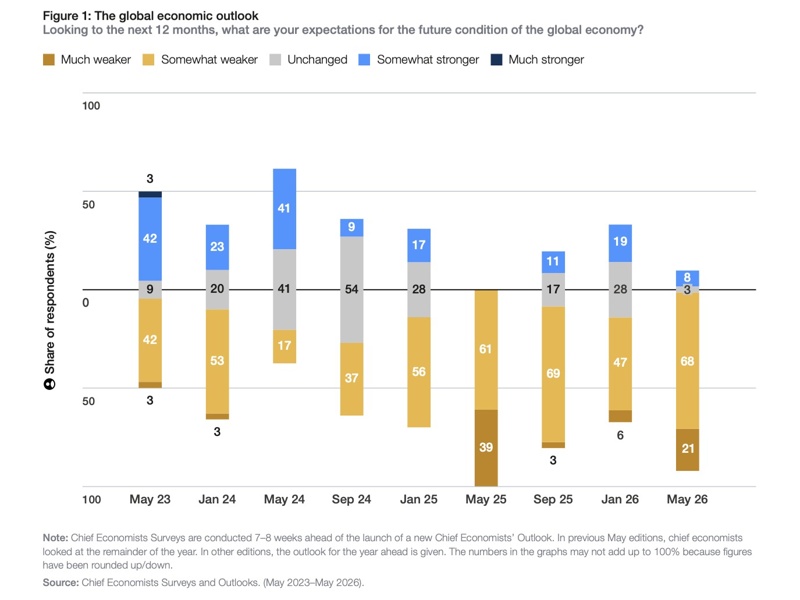
The cautious optimism that prevailed at the beginning of 2026 has given way to growing concern amid the escalation of the conflict involving Iran. Some 89% of chief economists expect global economic growth to weaken over the next 12 months, while 21% foresee a significant deterioration.
Particular concern surrounds the closure of the Strait of Hormuz, which handled around 10% of global maritime freight traffic before the crisis.
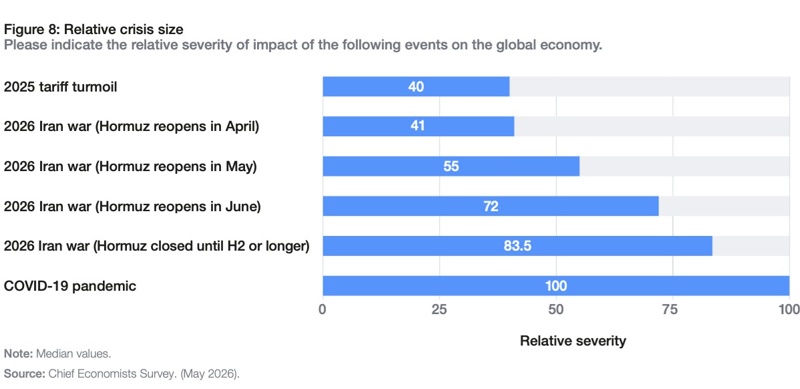
The authors of the report emphasize that “chief economists already place the current closure duration of the Strait of Hormuz decisively above the impacts of the 2025 tariff turmoil. Were the status to remain unchanged, the impact on the global economy is expected to approach levels last seen during the COVID-19 pandemic.”
Strikes on the region’s energy infrastructure have already disrupted supplies of oil, liquefied natural gas, and fertilizers. Against this backdrop, Brent crude prices temporarily exceeded $125 per barrel.
The crisis is expected to accelerate inflation and increase costs worldwide. Nearly 94% of respondents anticipate stronger inflationary pressures over the next year, driven primarily by rising energy and food prices.
“With energy and food making up a significant share of household consumption around the world, rising prices in these categories are likely to push global inflation higher,” the report says.
The energy and raw materials sectors are bearing the brunt of the crisis. They are followed by logistics and transportation, which have faced major disruptions to established supply routes. Tourism, aviation, and the defense industry are also experiencing significant pressure.
The report also highlights risks to global food markets. Prior to the conflict, up to 30% of international fertilizer trade passed through the Strait of Hormuz. Disruptions in supplies of sulfur, ammonia, and other key components have already pushed fertilizer prices higher. In the second half of the year, this could negatively affect crop yields and intensify food inflation.
Regional forecasts remain uneven. The most resilient outlooks are seen in India, the United States, and China, while Europe faces growing risks of stagflation amid the energy shock.
The sharpest deterioration in expectations has been recorded in the Middle East and North Africa, where economists foresee slower growth, weaker labor markets, and rising inflationary pressures.
Central Asia continues to maintain relatively favorable prospects, with nearly three-quarters of respondents expecting moderate or strong economic growth over the next year. Inflation, however, remains one of the region’s key risks.
Despite the worsening economic environment, artificial intelligence remains one of the few sources of optimism. As the report notes, “AI continues to be a bright spot in an otherwise challenging economic outlook, with respondents expecting the strongest gains in information technology, digital communications, financial services and education.”
More than 90% of respondents expect AI adoption to continue expanding over the next 12 months.
At the same time, expectations regarding AI-driven productivity gains have become more restrained. While economists previously anticipated a rapid and broad impact, many now believe that realizing the technology’s full potential will require more time and additional investment in infrastructure, workforce training, and business process modernization.
Amid rising geopolitical uncertainty, multinational companies are also reassessing their strategies. The United States, India, and Southeast Asia were identified as the most attractive destinations for business over the next 12 months. Europe continues to benefit from regulatory stability and strong consumer purchasing power, while China’s attractiveness is constrained by intense competition and lower profit margins.
The report concludes that the global economy is entering a period of heightened uncertainty, in which geopolitical conflicts, inflationary pressures, and the restructuring of global supply chains are likely to have a far greater impact on economic growth than was expected just a few months ago.
Earlier, Qazinform News Agency reported that the Supreme Eurasian Economic Council approved the launch of negotiations on a free trade agreement between the EAEU and Tunisia and endorsed a joint statement on the responsible development of artificial intelligence technologies.