U.S. midterms to decide balance of power in Washington
U.S. voters head to the polls on November 3 to decide control of Congress, with economic concerns dominating a contest that will shape President Donald Trump’s ability to govern for the next two years, Qazinform News Agency correspondent reports.

Although Trump is not on the ballot, the elections represent a major test of his second administration. Held halfway through a president’s four-year term, midterms determine the composition of Congress, the legislative branch responsible for passing federal laws, approving spending and overseeing the executive branch. Losing control of either chamber would make it harder for the president to implement his domestic program, while potentially increasing scrutiny of his foreign policy.
Voters will elect all 435 members of the House of Representatives and 35 of the Senate’s 100 members. House seats are distributed among states according to population, while every state has two senators regardless of its size. Republicans currently control both chambers, including a 53-47 Senate advantage when independents aligned with Democrats are counted. Democrats need a net gain of four Senate seats to secure a majority, since Vice President JD Vance can cast the deciding vote in an evenly divided chamber.
The two contests present different challenges. Democrats are favored by election forecasters to win the House, where Republicans hold only a narrow majority. Taking the Senate requires victories across several separate statewide races, including in places that have traditionally supported Republicans. This distinction matters because a party can attract more support nationally without winning the particular states needed to control the Senate.
Economic pressures are central to the campaign. A Pew Research Center survey conducted from September 28 to October 4 found that 84% of registered voters considered the economy very important to their congressional vote. It ranked first among supporters of both parties, ahead of healthcare, immigration and foreign policy. For Republicans, this creates a difficult political test: voters concerned about everyday expenses can hold the governing party responsible, even when the causes of those pressures extend beyond Washington.
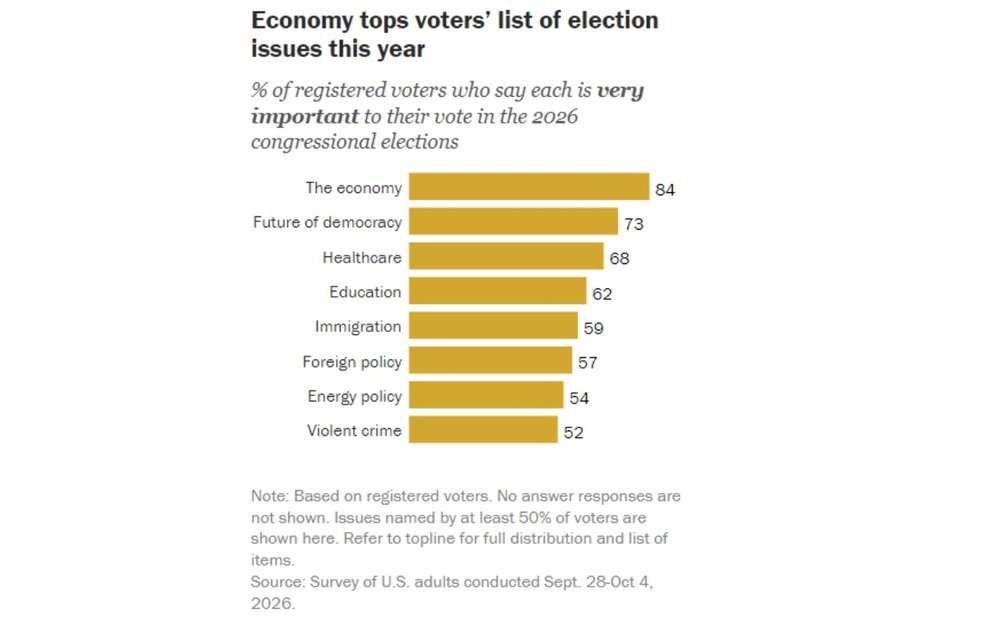
Other priorities reveal a divided electorate. Democratic supporters place greater emphasis on healthcare and the future of democracy, while Republican supporters attach more importance to immigration and violent crime. The war in Iran has also brought foreign policy into the campaign, connecting questions about U.S. military involvement abroad with domestic concerns over prices and the administration’s broader direction.
One of the most closely watched races is in Texas, a longstanding Republican stronghold. Republican Attorney General Ken Paxton faces Democratic state legislator James Talarico after defeating incumbent Senator John Cornyn in the Republican primary runoff. Primaries are the contests through which parties select their candidates before the general election. Cornyn’s defeat removed an established Republican senator before voters from both parties had their say.
The competitive general election in Texas adds another dimension. The state last elected a Democratic U.S. senator in 1988, making a Democratic victory a substantial political breakthrough. Even a close result would attract attention to whether the Republican coalition is holding together across suburban communities, Latino voters and supporters of the defeated incumbent. However, a competitive campaign does not by itself establish that the state’s longstanding political alignment has changed.
Michigan is another key battleground, where Democrat Abdul El-Sayed and Republican Mike Rogers are competing for the Senate seat being vacated by retiring Democrat Gary Peters. Unlike Texas, where Democrats are seeking a Republican-held seat, Michigan is one they must defend. Losing it would force Democrats to secure an additional victory elsewhere to reach a Senate majority, making the contest important to both parties’ national calculations.
🚨 BREAKING UPDATE: ANOTHER Michigan Democrat crosses over! Former Detroit Congressman Hansen Clarke (D) just endorsed Mike Rogers (R) for U.S. Senate over Abdul El Sayed "Choi Clarke and I stand with Congresswoman Haley Stevens in supporting Mike Rogers for the U.S. Senate." “I served with Mike in the U.S. House of Representatives. I know that he is committed to improving the quality of our lives, protecting our nation's security, and working with Democrats to get the job done." First Haley Stevens, now Hansen Clarke!! The people who know Abdul's party best are running to Rogers the day before the election 🔥 The Democrats in Michigan are PANICKING! FOLLOW ME THE NEXT DROP WILL BE SHOCKING
— Eagle Signal Usa🇺🇸 (@EagleSignalUsa) November 2, 2026
The Michigan race also produced a late campaign surprise when Haley Stevens, who had competed against El-Sayed for the Democratic nomination, endorsed Rogers shortly before Election Day. Her decision exposed divisions following a contentious primary and complicated efforts to unite Democratic voters. The episode illustrates how internal party disagreements can influence a contest with consequences for the national balance of power.
Elsewhere, Democrats are relying on candidates with strong local recognition. Former Governor Roy Cooper is contesting a Republican-held Senate seat in North Carolina, while former Senator Sherrod Brown is seeking a return to the chamber in Ohio. In Maine, Republican Senator Susan Collins faces Democrat Troy Jackson. Together, these races test how far a candidate’s personal standing can outweigh national party loyalties.
Another defining feature has been the redrawing of congressional districts between the usual once-a-decade revisions. Republican-led changes in Texas and other states, alongside Democratic efforts in California, have reshaped the House battlefield. Because representatives are elected district by district, changing boundaries can alter which party has the advantage without a comparable shift in national public opinion. Consequently, nationwide polling offers only a partial picture of the likely result.
Advance participation has also been substantial, with more than 43 million early or mail ballots recorded in data published five days before Election Day. That exceeded the equivalent stage of the 2022 midterms by nearly 10 million. The increase indicates strong use of early voting, although it cannot establish the eventual winner or guarantee higher overall turnout.
For international observers, the central question is how the result changes Washington’s ability to act. A Democratic-controlled chamber could obstruct legislation, challenge spending proposals and intensify investigations, while a Democratic Senate would also influence the approval of senior officials and judges. Trump would retain the presidency and substantial executive authority, particularly in foreign affairs. The election will therefore determine the constraints surrounding his administration, with implications for the predictability of U.S. decisions on trade, security and international cooperation.
Earlier, Qazinform reported that U.S. Secretary of State Marco Rubio emphasized economic growth and security during G20 talks in Atlanta.