Love has a point of no return: What mathematics reveals about relationships
Why does one couple recover from a serious conflict while another continues to drift apart long after the argument is over? Mathematical models suggest that relationships may have their own “point of no return,” Qazinform News Agency reports.

The renewed interest in the subject follows the publication of Love! Valour! Equations! Mathematics of the Couple by Laurent Pujo-Menjouet, a professor at Claude Bernard University Lyon 1. According to Taylor & Francis, the book brings together several decades of mathematical research into romantic relationships.
The first models of this kind appeared in the 1980s. In his 1988 paper Love Affairs and Differential Equations, mathematician Steven Strogatz proposed treating the feelings of two people as a dynamical system whose state changes continuously under the influence of the partners and external circumstances.
In 1998, Italian mathematician Sergio Rinaldi developed a model consisting of two equations, one for each partner. According to his study Love Dynamics: The Case of Linear Couples, changes in a person’s feelings depend on three factors: the natural fading of affection, the response to being loved and the partner’s appeal.
Appeal includes not only physical appearance but also the range of qualities one person values in another. The model also takes into account that people respond differently to displays of affection. A partner’s attention may draw one person closer while causing another to pull away.
Rinaldi, Fabio Della Rossa and Fabio Dercole later divided couples into two categories: robust and fragile. Their findings were published in Love and Appeal in Standard Couples.
A robust couple has a single stable equilibrium in the model. Following an argument or another shock, the relationship gradually returns to its usual state. A fragile couple can have two stable states: a positive one in which the partners retain affectionate feelings and a negative one associated with emotional detachment.
A mathematical boundary separates these states. If stress, conflict or another external problem is strong enough, the relationship may cross that boundary. The partners’ feelings can then continue moving toward the negative state even after the original cause of the crisis has disappeared.
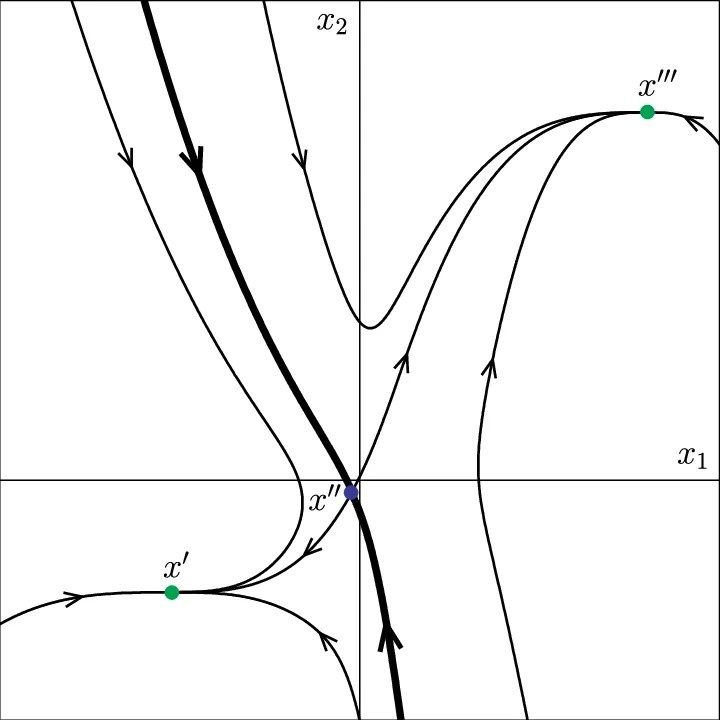
Popular accounts describe this boundary as a relationship “danger zone.” However, there is no universal threshold for all couples. Its position depends on the partners’ emotional responsiveness, the strength of their reactions to each other and the relationship’s initial condition.
Economist José Manuel Rey proposed another mathematical approach. In A Mathematical Model of Sentimental Dynamics Accounting for Marital Dissolution, he treated a relationship as a system that gradually deteriorates without a continuous investment of effort.
The model identified what researchers call an “effort gap.” The level of effort required to maintain a happy long-term relationship is higher than the amount partners would prefer to invest if they were concerned only with their immediate comfort. This creates a tendency to gradually reduce the time and energy devoted to the relationship.
According to the model, such lapses do not necessarily cause an immediate breakup. Instead, each period of insufficient effort moves the relationship further away from its desired trajectory. Since the system is inherently unstable, the lost ground is not recovered automatically, and repeated lapses can produce a gradual decline.
Eventually, the relationship may fall below a minimum acceptable level. Rey describes this threshold as a point of “pre-rupture.” It does not mean that separation happens immediately, but indicates that the relationship has become so weakened that further withdrawal of effort may make its collapse increasingly difficult to prevent.
In the later study Controlling Forever Love, Rey and Jorge Herrera de la Cruz used computer simulations to examine long-term relationships. Their first simulation suggests that satisfaction in a successful relationship may initially decline before reaching a stable plateau. During illness, financial difficulties or other crises, the effort needed to sustain the relationship temporarily increases.
A separate simulation of a prolonged crisis shows a U-shaped trajectory. If partners respond to deterioration by increasing their investment in the relationship, recovery may follow the decline. Without that response, the downward trend may continue.
Other studies have examined the effect of delayed reactions. In Delay Can Stabilize: Love Affairs Dynamics, mathematicians Natalia Bielczyk, Marek Bodnar and Urszula Foryś found that a moderate delay can stabilize certain relationship models.
In other words, pausing before responding during a conflict may sometimes prevent emotional escalation. However, an excessively long delay may instead produce instability and recurring fluctuations in feelings.
Mathematical equations cannot calculate the exact date on which a couple will separate. The research is based primarily on theoretical models and computer simulations rather than long-term observations of individual couples.
According to Pujo-Menjouet, the central question is not whether partners argue, but whether their relationship is resilient enough to return to equilibrium after a conflict.
Earlier, Qazinform News Agency reported on how artificial intelligence is transforming dating, marriage and human relationships.