Kazakhstan, Germany agree to expand agricultural cooperation
As part of the Head of State’s official visit to Germany, Kazakh Minister of Agriculture Aidarbek Saparov met with Markus Schick, State Secretary at Germany’s Federal Ministry of Agriculture, Food and Regional Identity, Qazinform News Agency cites the Kazakh Ministry of Agriculture.

“We highly value our partnership with Germany. Agricultural cooperation is particularly important for Kazakhstan and has a strong practical focus. We see significant potential to further increase bilateral trade, expand investment cooperation, and introduce modern German technologies into Kazakhstan’s agricultural sector,” Saparov said.
Agricultural trade between Kazakhstan and Germany grew 23% in 2025, while Kazakhstan’s agricultural exports to Germany increased 38%. The upward trend continued in the first seven months of 2026, with bilateral trade rising another 8.8% year-on-year.
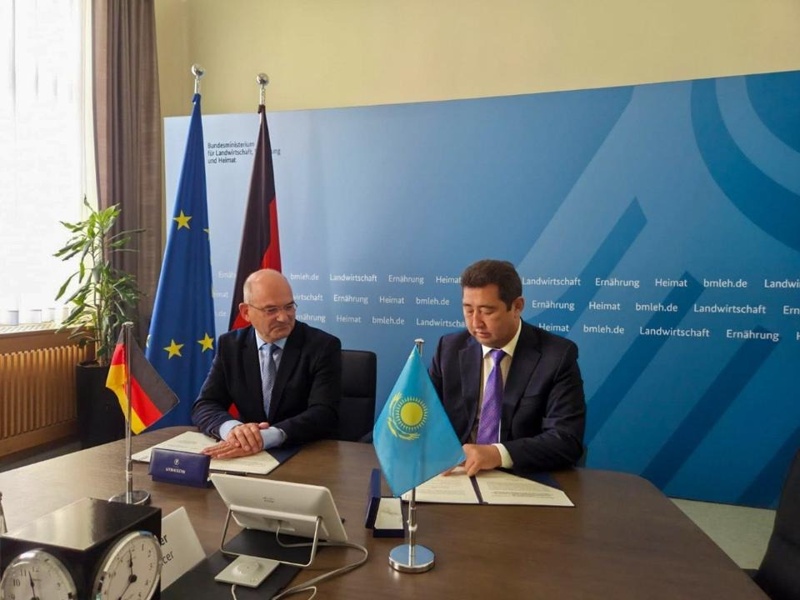
The two sides agreed to further expand bilateral trade, attract investment, localize production, and develop high value-added projects. They also discussed ways to increase the presence of Kazakh agricultural products in the European market, including potential horsemeat exports to the European Union.
The German-Kazakh Agricultural Policy Dialogue, launched in 2009, remains a key platform for bilateral cooperation. Its sixth phase began in September 2026, with Kazakhstan taking on a broader role as a regional platform for sharing agricultural expertise and experience with other Central Asian countries.
Cooperation in dairy farming has also expanded. Since 2019, Germany has provided Kazakh enterprises with consulting and expert support under a joint sustainable milk production project, with more than 400 specialists receiving training. The project has been extended through 2027.
Another major area of cooperation is the localization of agricultural machinery production by German manufacturer CLAAS in Kazakhstan. Around 2,100 units of machinery worth approximately 270 billion tenge have been produced since the project was launched.
The two countries also identified seed production and breeding, organic farming, digitalization, precision agriculture, scientific research, and technology transfer as promising areas for further cooperation.
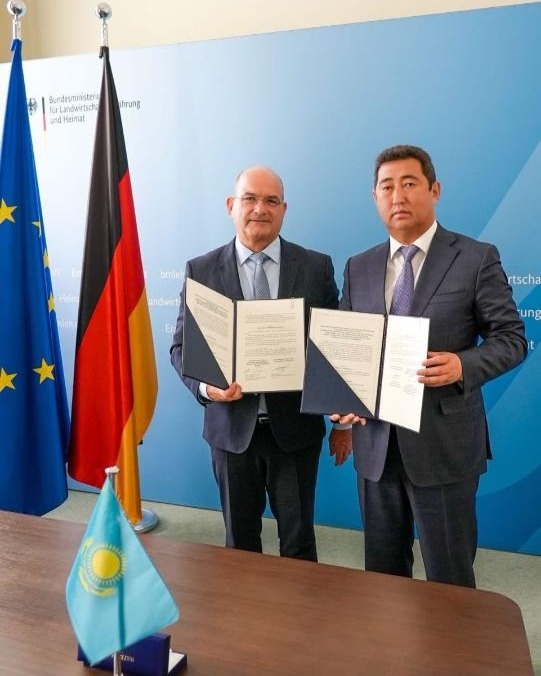
Following the talks, the two sides signed the Declaration of Intent covering agricultural policy, trade in agricultural and food products, digitalization and precision farming, organic production, phytosanitary and veterinary issues, and other areas.
Under the agreement, Kazakhstan and Germany plan to expand exchanges of expertise and technology, strengthen ties between research and educational institutions, industry associations and businesses, and pursue joint research, investment, and pilot projects.
Saparov said the declaration would provide a stronger foundation for attracting investment, transferring technology, and launching new joint projects. He also proposed establishing a working group to promptly address issues arising in bilateral agricultural cooperation.
The Kazakh Agriculture Minister also met with German Agribusiness Alliance Managing Director Per Brodersen.
The German platform brings together associations and companies from Germany’s agricultural and food sectors and promotes cooperation with countries in Eastern Europe and Central Asia.
During the meeting, the sides discussed ways to further strengthen cooperation in agriculture and the food industry, introduce advanced German expertise, innovations, and modern agricultural technologies, and support joint projects.
Earlier, Kazakh Prime Minister Olzhas Bektenov instructed the Government to ensure the timely completion of the country’s harvesting campaign.