Kazakhstan becoming key crossroads of Eurasia — Iranian President Masoud Pezeshkian
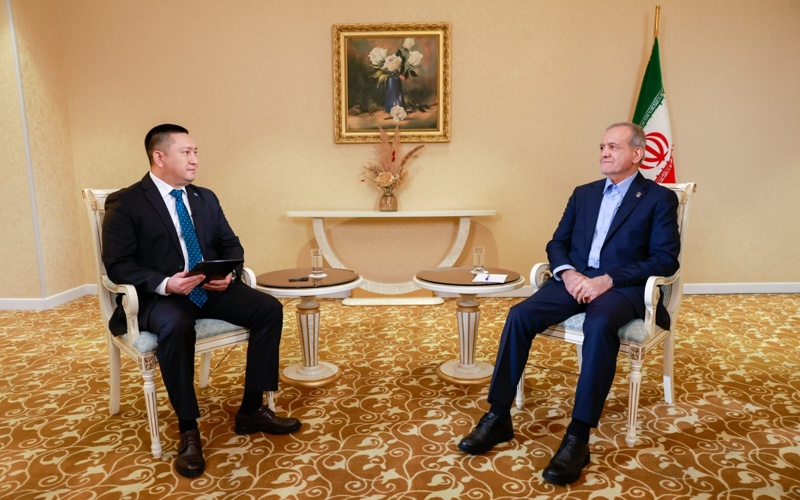
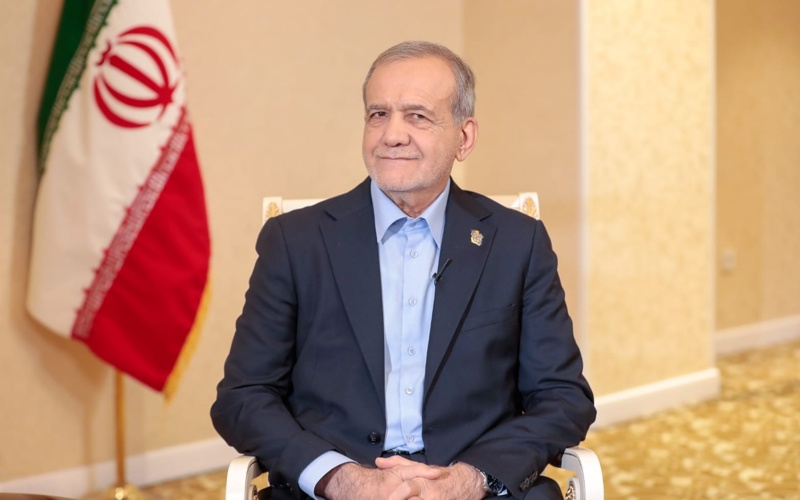
Iran is ready to provide Kazakhstan with access to the Persian Gulf, the Gulf of Oman (the Arabian Sea), the Indian Ocean, as well as to eastern and western transport routes. President of the Islamic Republic of Iran, Masoud Pezeshkian, stated this in an exclusive interview with the TV and Radio Complex of the President of the Republic of Kazakhstan.

As we meet now in Astana during your official visit, one of the first questions is: Mr. President, Kazakhstan and Iran are demonstrating noticeable growth in trade. However, the target figure of 3 billion dollars has not yet been reached. What could accelerate achieving this goal?
At the first stage, the most important thing is to strengthen ties between our countries so that we can build the kind of relationship necessary to achieve the stated goals. Later, as political contacts expand and mutual understanding deepens, the next inevitable step is to simplify the visa regime. This will allow citizens of the two countries to interact freely in political, economic, scientific, cultural spheres and in the field of security. Such an approach creates the foundation for a whole range of joint actions that will bring good results.
If we specify these areas, then a clarifying question arises: What benefits does a full-scale free trade agreement with the EAEU bring to Iran? What new opportunities does this open for Kazakhstan and Iran?
Now that we have entered the Eurasian observer format, it has ensured our presence in this space. The economic environment of Eurasia opens opportunities both for our countries and for all participants in the format. Iran has a large market — almost 90 million people, which creates broad prospects for Kazakhstan. And naturally, for Iran, Kazakhstan and the countries of Eurasia also form a favorable environment for expanding economic exchanges. Such a platform, by removing tariff barriers, becomes an effective tool for entrepreneurs, industrialists and producers, facilitating interaction and strengthening mutual support.
In connection with this interest, a Kazakhstani logistics center is being created in the south of Iran, which is attracting great interest. How will this affect the development of the North–South corridor when we speak about trade between our countries?
To achieve the goals you mentioned, there must be joint transport arteries between our countries and the states of Eurasia. These routes may take shape by sea, by rail and by air. If we are able to expand the railway route from Kazakhstan toward the port, and if a logistics center of brotherly and friendly Kazakhstan is created in our southern port, then the economic and cultural tasks we set will be accomplished much more easily.
We are ready to jointly take all necessary steps to ensure routes of access — to the Persian Gulf, the Gulf of Oman, the Indian Ocean, as well as to eastern and western directions. This will create a strong foundation for subsequent exchanges — cultural, economic, political and in the field of security.
Kazakhstan and Iran actively cooperate in the Caspian region. What is the role of our countries in maintaining security and environmental balance in our sea?
The Convention on the Legal Status of the Caspian Sea is a common framework for cooperation among the Caspian littoral states. We, as two brotherly states of the region, must cooperate to preserve the Caspian: its ecology, its water resources and the sustainability of trade and economic activity. If we act within transparent and understandable frameworks, we can preserve the Caspian Sea as a space of ecological life and as a trade and economic corridor to the east, west, north and south. This will also allow us to protect the waters of the region from pollution and preserve the vital natural environment.
In this regard, do you think all Caspian littoral states are maintaining the correct environmental balance of the Caspian Sea today? Or does something need to be changed?
To preserve the world we live in, it is necessary that specialists and experts in the marine environment work on the basis of a unified vision and a shared scientific approach. When such an approach is formed, politicians, entrepreneurs and all stakeholders can make further decisions relying on science and care for the region. If, however, we act without scientific grounds toward nature, without considering climate change, then it is possible that even in the near future we could cause serious damage to the countries located on the Caspian Sea.
Mr. President, citizens of Kazakhstan show active interest in your country, and in this regard, the following question: are there plans to simplify visa procedures and increase the number of direct flights between Kazakhstan and Iran to stimulate tourism and business contacts?
Naturally, we are very interested in developing the process you are talking about. I am convinced that our countries have had deep cultural ties, shared beliefs and close interaction for thousands of years. Therefore, travel between Islamic and neighboring countries should become easier. We have already simplified visa procedures for business representatives to 14 days, but I believe these opportunities should be expanded — made even simpler and more accessible. This includes air travel and land routes. We came here precisely to advance processes in tourism and trade.
At the same time, Iran is actively developing medicine, biotechnology and high technologies. Which scientific areas could become the basis for bilateral relations and research?
We discussed in detail that we can easily open routes for each other — air, land, sea. This greatly simplifies the development of ties, including scientific and medical ones. Today Iran largely meets its medical needs with its own forces and has achieved significant results in biotechnology, nanotechnology and medical technologies, having been able to fully resolve its issues to the extent possible.
These capabilities in the medical field can be combined with Kazakhstan’s potential. As Muslim and neighboring states, we can transfer knowledge, experience and skills to each other and strengthen our capabilities. We believe that as Muslims and neighbors, we can build a world where friendship, health, science and knowledge grow, and we hope for the expansion of cooperation in the scientific and medical fields.
Moving to other topics. How do you assess the role of Kazakhstan and Iran in ensuring regional stability amid a changing international environment?
The most important task in the modern world is to create a healthy, peaceful, just and safe environment for all people. If we strengthen our belief that we can build such a foundation for ourselves, for our neighbors, for the entire region and continent, and maintain unity and cohesion, this will open the way for future generations. Instead of conflicts, we must help one another — in science, healthcare, the economy, environmental protection and ensuring peace. Based on mutual trust, we can live the time granted to us by God in peace, kindness and cooperation.
Mr. President, in your view, what is Kazakhstan’s role in ensuring stability and international security?
Kazakhstan is experiencing a stage of rapid development and can become an important crossroads between East and West, North and South. Rapid development makes it possible to strengthen cultural, scientific, artistic and socio-political interactions. If we expand routes and deepen interaction, Kazakhstan will be able to become the cultural hub of the region. This will bring the views of peoples closer, strengthen calm and accelerate development.
Our entrepreneurs, investors, scientists and cultural figures will be able to build connections much more easily. I am convinced that Kazakhstan, Iran and the countries of the region are in no way inferior to those who have advanced further, and we can help each other and reach these heights.
On which international platforms such as the SCO, CICA, OIC do you see the greatest potential for strengthening cooperation between our countries? On which platforms do you see more contact with Kazakhstan and shared views in addressing international issues?
Different platforms and agreements complement one another: some — in economics, others — in security, others — in political and socio-regional issues. Today we face a certain problem — financial and banking ties. We need to simplify these mechanisms so that entrepreneurs can work freely. Within BRICS, the creation of a bank is being discussed that will allow participating countries to conduct economic operations within a common currency system. The Eurasian format removes tariff barriers, ensuring the free movement of goods. Islamic mechanisms of cooperation also create wide opportunities — this is unity, cohesion and a large market of Muslim countries. It is important to direct all these instruments in the right direction — toward the development and expansion of cooperation.
Thank you, Mr. President. The last question: how well are you acquainted with our President, Mr. Tokayev, and how do you assess his efforts and work in addressing international issues?
We are well acquainted with your president and his experience. He is capable of much, as he has held various important positions — Chairperson of the Senate of the Parliament, Minister of Foreign Affairs, and today he is President. With the experience, knowledge and motivation he possesses, he can be very effective and play a very significant role in creating interactions and facilitating joint processes.
He visited Iran more than once during his tenure as foreign minister, he knows regional politics well, as well as legislative and legal frameworks. In my view, his position as president of the dear people of Kazakhstan creates very favorable opportunities for implementing his constructive views and intentions — both inside the country and in the region.
As Qazinform News Agency previously reported, the President of Kazakhstan, Kassym-Jomart Tokayev, and the President of Iran, Masoud Pezeshkian, made a Joint Statement following the talks in Astana.