Kazakhstan and China launch high-precision nanosatellite into orbit
A jointly developed Kazakhstan-China nanosatellite has been successfully launched into orbit, Qazinform News Agency reports, citing the Kazakh Ministry of Science and Higher Education.

The nanosatellite, developed by Al-Farabi Kazakh National University and China’s Northwestern Polytechnical University, was placed into orbit on December 13 at an altitude of 530 km.
The research spacecraft was delivered into space aboard the Di’er-5 spacecraft (Yao-8 mission) operated by Ziwei Aerospace, using a Kuaizhou-11 launch vehicle.
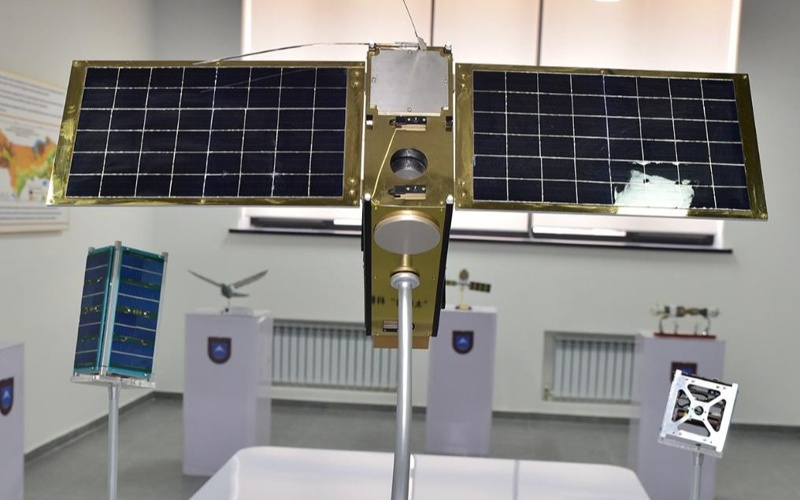
The nanosatellite is designed to carry out several advanced scientific tasks, including high-stability target tracking, dynamic orientation sensing and compensation using flexible sensors, and autonomous recognition of Earth observation images based on the open-source OpenHarmony operating system.
According to the ministry, the project offers four key advantages: cost efficiency through the use of commercial components and innovative design, high stability and pointing accuracy, powerful onboard computing capabilities for adaptive error compensation, and rapid data transmission to Earth.
The project was implemented with the support of the Northwestern Polytechnical University branch at KazNU, the National Joint Research Laboratory under the Belt and Road Initiative, the Aerospace Institute, and the National Key Laboratory of Flexible Electronics.

Academician Huang Wei is an advisor to the project. Overall leadership is provided by Professor Yue Xiaokui, and KazNU Professor Zaure Rakisheva, serving as deputy project leader. More than 20 researchers and young experts from Kazakhstan and China have been involved in the joint research team.
The collaboration opens up new opportunities for space research, training of highly qualified specialists, and the development of future joint satellite projects, also enabling advanced Earth remote sensing capabilities using microsatellite technology.
As reported earlier, China launched a group of new internet satellites.