Kazakhstan aims to build 5 GW capacity for regional AI computing hub
Kazakhstan's plans to build a full-scale AI economy and expand its computing capacity took center stage as AI & Digital Bridge 2026 opened its second day in Astana on Friday, Qazinform News Agency correspondent reports.

Speaking at a panel session, Deputy Prime Minister and Minister of Artificial Intelligence and Digital Development Zhaslan Madiyev said Kazakhstan aims to systematically develop all five layers of the AI economy, from energy and chip infrastructure to large language models and applied solutions. He noted that AI technologies are still at a very early stage of development, while the total potential AI market already exceeds $50 trillion, according to various estimates.
Madiyev listed the five layers as energy infrastructure, chips, access to cloud platforms, the development of large language models, including local and sovereign ones, and applied solutions. Since it is still difficult to predict which of these layers will generate the most added value and profit, he said, Kazakhstan has chosen to develop all five so as not to miss out on opportunities once AI becomes a routine part of economic and business activity.
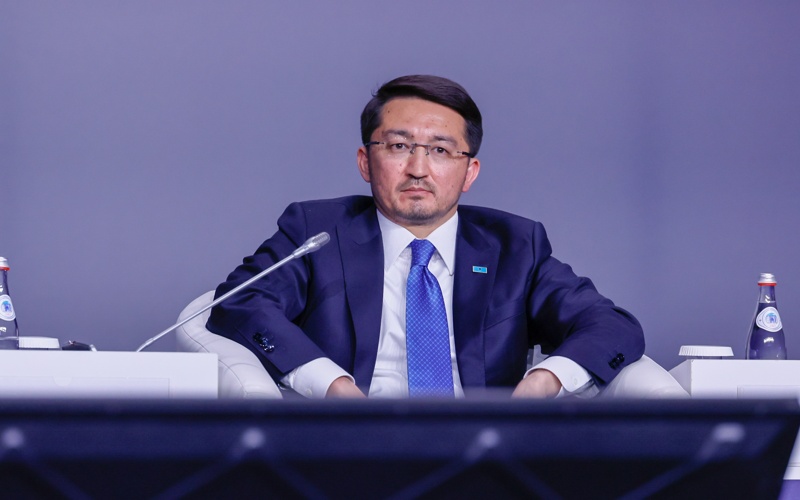
According to the minister, pursuing sovereignty in AI does not mean developing every technology independently. He stressed the importance of cooperating with other countries and major global tech companies while keeping a diversified approach. Noting that Kazakhstan does not yet produce chips, Madiyev said the country needs to build relations with partners in both the West and the East and maintain good ties with regulators and agencies responsible for export controls to secure access to critical technologies.
He added that large language models developed in Kazakhstan should reflect local content and cultural context, which requires capacity-building programs. In his view, the country stands to gain the most at the level of applied solutions that can be deployed across the economy and people's daily lives.
AI infrastructure was also in focus on the second day. Bagdat Mussin, Chairman of the Management Board of Kazakhtelecom, said Kazakhstan intends to develop AI computing capacity by drawing on its energy potential, telecommunications infrastructure and international digital links.
According to Mussin, the country should start by making use of the resources it already has, including coal, which can be converted into energy to build computing capacity. He noted that global demand for computing power is high, and said that by combining data center development with cooperation with technology companies such as NVIDIA, Kazakhstan could build its own competencies in the field. He added that the country's location would allow it to serve as a regional hub offering digital services to Central Asian countries.
Mussin also stressed that computing power alone is not enough for the AI revolution, pointing to the need for strong connectivity with the global digital space. He highlighted the development of Kazakhstan's fiber-optic infrastructure and data transit routes across the Caspian region, with one goal being to cut data transmission latency to 45 milliseconds. He said Kazakhstan has the opportunity to create an additional 5 GW of energy capacity that could be used to develop computing infrastructure.
The three-day forum runs from October 1 to 3 at the EXPO International Exhibition Center and is organized by the Ministry of Artificial Intelligence and Digital Development, Astana Hub and the Astana city administration. It serves as the central event of AI Month, held as part of Kazakhstan's Year of Digitalization and Artificial Intelligence. While the first day featured an invitation-only, high-level program, the second and third days are open to ticket holders.
The forum opened on Thursday, October 1, with a plenary session addressed by President Kassym-Jomart Tokayev. Speaking on the opening day, the President said Kazakhstan's exports of IT services exceeded $1 billion last year and proposed launching an AI Challenge for Kazakh and international teams based on a list of industrial AI challenges. He also called for a risk-based approach to regulation.
"We must not overregulate this sphere to the point where promising teams, technologies and capital begin moving to other jurisdictions," he said.
Earlier, Qazinform News Agency reported that NVIDIA is set to participate in the next phase of Kazakhstan’s Data Center Valley project in Ekibastuz. During a meeting with company representatives, President Kassym-Jomart Tokayev emphasized the importance of expanding AI use across priority economic sectors. Two supercomputing clusters based on NVIDIA technologies have already been launched in Kazakhstan.