Felt as cultural memory: Aruhan’s exhibition connects Kazakh heritage to contemporary art
An ongoing exhibition in Astana presents felt works by artist Gaukhar Bissengalieva, that reinterpret the material traditions of the Great Steppe for a modern and international audience, Qazinform News Agency correspondent reports.

The exhibition Felt Memory and Silence offers an opportunity to encounter Kazakh felt craft through the lens of contemporary art. More than 30 works by Gaukhar Bissengalieva, known professionally as Aruhan, transform an ancient domestic practice into a reflective visual language addressing memory, continuity, and cultural identity.
Bissengalieva builds upon this heritage using traditional wet felting and natural materials only, completing each work herself without assistants. She does not design forms in advance, allowing them to arise during the process, mirroring the intuitive rhythm of handmade craft rather than industrial production.
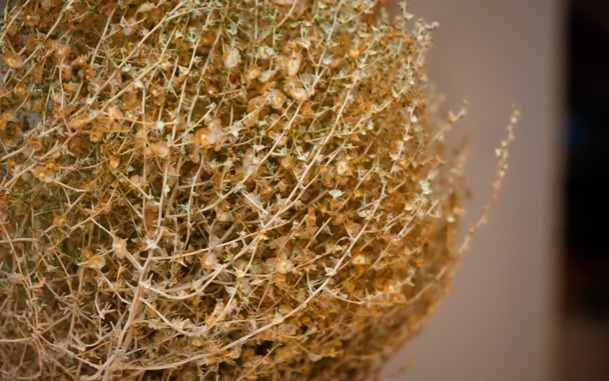
Felt symbolizes home comfort, the family hearth, and the age-old traditions of the Kazakh people. It played a key role in rituals and ceremonies, such as the ceremony of the khan's installation on a white felt rug, as well as in weddings and funerals, becoming an integral part of daily life and cultural heritage.
The artist integrates grasses and branches collected from the steppe and aged to achieve natural tones, placing the landscape itself in dialogue with the felt. In this way, the steppe becomes more than a backdrop to the work; it acts as a participant in creation.
Light plays an equally important role. This is why transparent framing was chosen, as it underscores the fragile, almost phantom-like nature of the imagery, as if energy has been caught in a fleeting moment. When backlit, the organic fibers of the felt reveal intricate structures reminiscent of the elaborate patterns seen in scientific illustrations, ranging from diagrams of the universe to visualizations of molecular processes.
Silence anchors the artist’s method. Each new piece begins with a visit to the steppe and the sound of the shankobyz, a traditional instrument used for focus and inward tuning.
The exhibition also incorporates a video installation based on archival materials from the Central State Archive of Film, Photo Documents, and Audio Recordings of the Ministry of Culture. A traditional kuy performed by the artist’s grandfather accompanies the visuals, lending the exhibition a deeply personal tone and turning family heritage into a living echo of the wider cultural memory of the steppe.
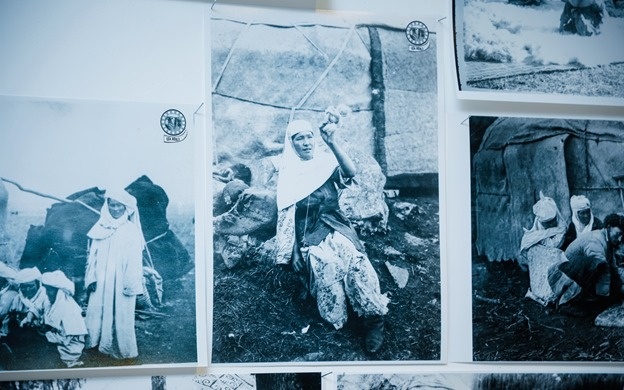
Bissengalieva’s artistic path bridges global and local experience. She first worked in the international music industry, collaborating with companies such as Sony, BMG, and EMI and organizing orchestral performances on leading world stages. Her return to felt marked a conscious shift toward ancestral craft as a contemporary artistic medium. Today, her works are held in private collections in the United Kingdom, Switzerland, and Italy, underscoring the growing interest abroad in artistic practices rooted in Central Asian traditions.
Earlier, Qazinform News Agency reported that Aruhan had transferred a unique collection of 19th-century photographs of Kazakh life, taken by George Frost, to the Central State Archive of Film and Photographic Documents.