Bank RBK outpaces largest second-tier banks in loan portfolio growth
As of July 1, 2026, there were 23 second-tier banks in Kazakhstan. In recent years, the country’s banking sector has demonstrated dynamic growth across all key perfomance indicators. At the same time, lending to the economy, which is one of the key drivers of economic growth in any country, is also increasing, Qazinform News Agency refers to Ranking.kz, citing statistics from the National Bank of Kazakhstan.

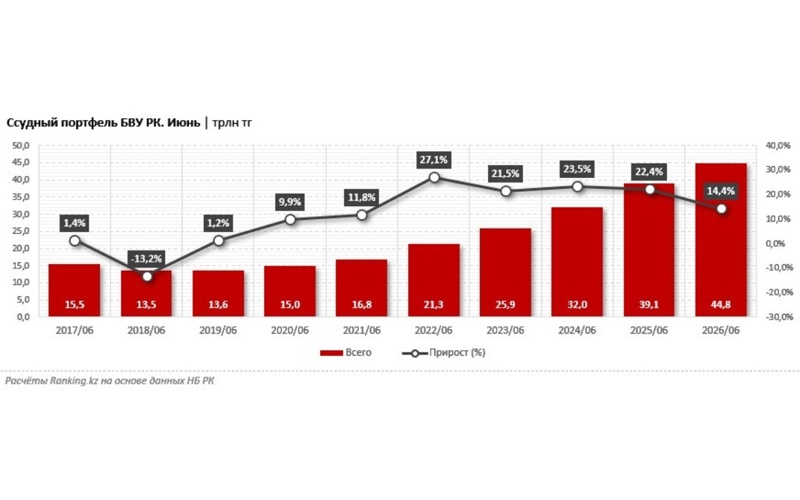
The loan portfolio of Kazakhstan’s second-tier banks reached 44.8 trillion tenge, up 14.4% compared with the same period last year. In monetary terms, lending to the economy increased by 5.6 trillion tenge.
It is important to note that despite the large number of banks in the country, market growth is being driven primarily by the largest players. More than 86% of the annual increase in the loan portfolio came from the largest financial institutions.
In addition, the performance of individual banks varies significantly. Overall, loan portfolio growth was recorded at only 15 of Kazakhstan’s 23 second-tier banks. Seven banks posted negative growth, including the two largest, while one financial institution had no year-on-year change.
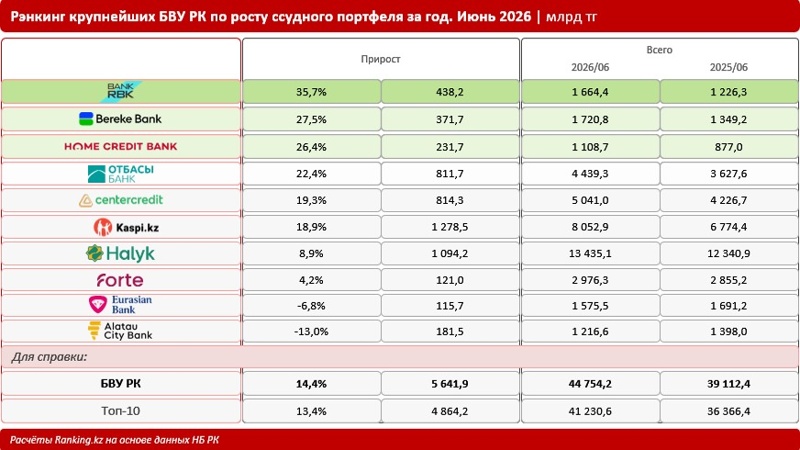
Bank RBK leads in annual loan portfolio growth: up 35.7%. This is more than twice the sector average and significantly higher than the growth recorded by other major second-tier banks in Kazakhstan. As of July 1, 2026, the bank’s loan portfolio had grown to 1.7 trillion tenge, compared with 1.2 trillion tenge a year earlier.
The bank’s leading position is not accidental: the financial institution offers a wide range of lending products for both businesses and individuals. Notably, more than half of Bank RBK’s loan portfolio is accounted for by lending to the corporate sector, that is, businesses. According to the bank’s recently published 2025 report, commercial lending increased by 32.5% over the year, while lending to small and medium-sized enterprises grew by 42.2%.
Thus, the growth in the loan portfolios of market leaders is partly driven by an increase in corporate lending volumes.
Bereke Bank ranked second among Kazakhstan’s largest second-tier banks in terms of annual loan portfolio growth, up 27.5% to 1.7 trillion tenge.
Home Credit Bank rounds out the top three in portfolio growth, up 26.4% to 1.1 trillion tenge.
It is important to note that the dynamic growth in bank lending has been driven specifically by the latest five-year period. Before that, the market experienced significant fluctuations and faced a number of difficulties. Over the past 5 years, the loan portfolio of Kazakhstan’s second-tier banks has grown more than 2.5 times, while the average annual growth rate from 2022 to 2026 was 21.8%, compared with 2.2% in the previous five-year period.
For clarity, let us look at the changes in the size of the loan portfolio over time:
– 2016: 15.3 trillion tenge → five years later, in 2021: 16.8 trillion tenge. Growth: 9.5%, or 1.4 trillion tenge.
– 2021: 16.8 trillion tenge → five years later, in 2026: 44.8 trillion tenge. Growth: more than 2.5 times, or 28 trillion tenge.
As for the current annual growth across the sector, the breakdown is as follows:
– loans to businesses (the non-financial sector) increased by 17%;
– loans to financial legal entities increased by 19.2%;
– loans to individuals increased by 14.6%.
Thus, bank lending in Kazakhstan continues to show strong growth, with the largest increase coming from loans to businesses. This indicates exapanding financial support for the entrepreneurial and real sectors of the economy, creating a foundation for further growth in business activity.
License No. 1.1.821.135, dated July 15, 2026, issued by the Agency of the Republic of Kazakhstan for Regulation and Development of the Financial Market
Earlier, Qazinform News Agency reported that Bank RBK received an award from the National Payment Corporation of Kazakhstan in recognition of its productive cooperation and contribution to the development of the country's national payment infrastructure.