Shenzhen’s experience to help shape Kazakhstan’s new megacity
During an official visit to the People’s Republic of China, Deputy Prime Minister of Kazakhstan Kanat Bozumbayev held a meeting with Shenzhen Mayor Qin Weizhong, Qazinform News Agency reports citing Alatau City official website.
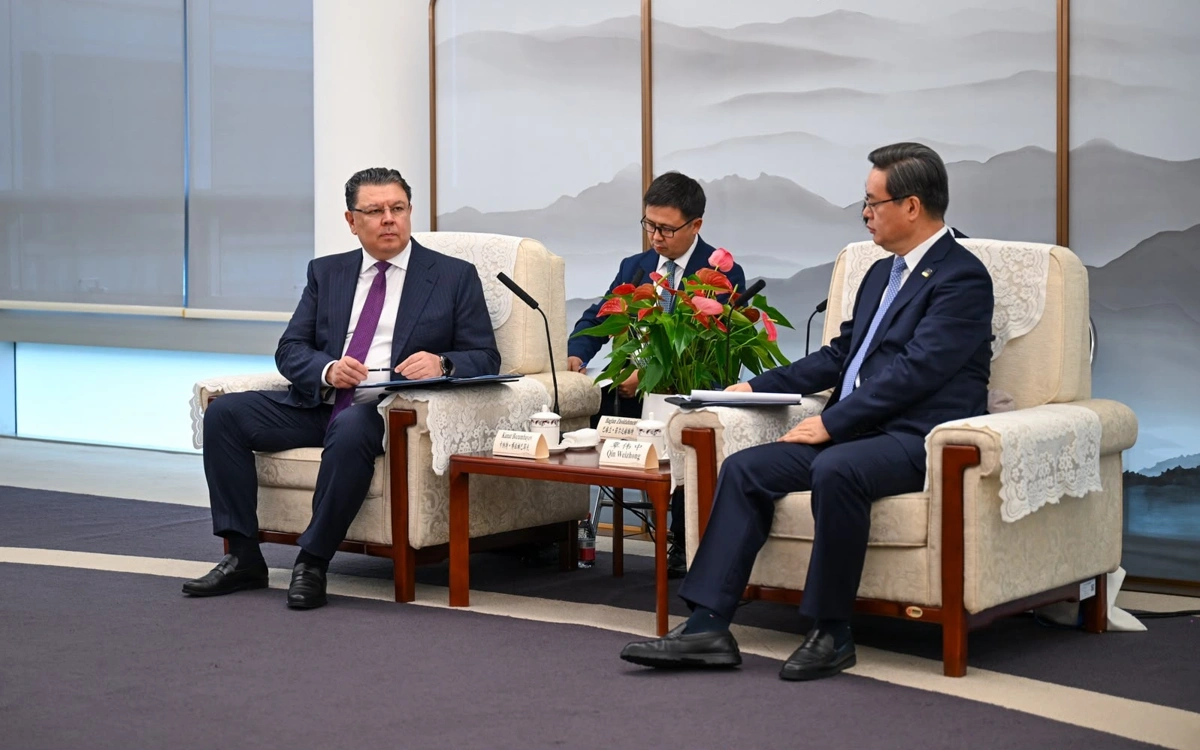
The discussions focused on strategic cooperation in the development of Alatau City, attracting high-value technology investment, and applying advanced urban development and governance practices.
The meeting marked a new stage in economic cooperation between Kazakhstan and Shenzhen. The development experience of Shenzhen - a city that transformed from a fishing village into one of the world’s leading centers of innovation and high technology is serving as an important reference point as Alatau City advances its long-term development strategy.
During the meeting, Deputy Prime Minister Kanat Bozumbayev drew parallels between major cities in Kazakhstan and China, outlining the role envisioned for Alatau City within the country’s future economic landscape.
“Astana is our Beijing, the political center of the country. Almaty is our equivalent of Shanghai, generating more than 20% of Kazakhstan’s GDP and serving as our financial and industrial hub. Our new city, Alatau, is Kazakhstan’s equivalent of Shenzhen. It is a city being built from the ground up with a mission to attract global talent, investment capital, advanced technologies, and to operate under a special legal regime,” Kanat Bozumbayev said.
He also noted that on May 8, President Kassym-Jomart Tokayev signed the Constitutional Law on the Special Legal Regime of Alatau City. For the first time in Kazakhstan’s modern history, a city has been granted a dedicated legal framework designed to support its long-term development and investment attractiveness. International best practices, including the experience of Shenzhen, were studied during the drafting process.
Mayor Qin Weizhong welcomed the Kazakh delegation and highlighted the strong momentum in bilateral relations. Expressing support for the development of Alatau City, he presented Shenzhen’s economic achievements and global standing.
“Shenzhen’s economy currently ranks third among Chinese cities, fourth in Asia, and among the world’s top ten. Shenzhen also ranks first among Chinese cities in terms of foreign trade volume and industrial output,” Qin Weizhong stated.
Transport and logistics emerged as the first major area of cooperation. Located just 180 kilometers from the Kazakhstan-China border, Alatau City is positioned to become a major multimodal logistics hub at the crossroads of the Silk Road. The future third railway border crossing between Kazakhstan and China is expected to further strengthen cargo flows and e-commerce connectivity. In this context, Kanat Bozumbayev invited Shenzhen-based businesses to participate in the development of a next-generation transport and logistics ecosystem in Alatau City.
The second priority area is the development of the digital economy and artificial intelligence. Mayor Qin Weizhong identified digital technologies including telecommunications, cloud computing, the Internet of Things, and robotics as key competitive advantages of Shenzhen. Kazakhstan invited Shenzhen’s leading technology companies to establish innovation centers and R&D facilities in Alatau City.
Green energy was identified as the third pillar of cooperation. Shenzhen is widely recognized for its leadership in sustainable urban development, with the share of new energy vehicles exceeding 80%. Combined with Kazakhstan’s significant wind and solar energy potential, this creates opportunities for cooperation in building a sustainable and technologically advanced urban environment.
The fourth pillar of cooperation focuses on expanding trade and investment. Bilateral trade between Kazakhstan and China reached a record USD 48.7 billion in 2025, while trade turnover during the first four months of the current year increased by an additional 32%. At the same time, Guangdong Province and Shenzhen currently account for USD 8.4 billion of this figure, indicating substantial untapped potential for future cooperation.
Mayor Qin Weizhong expressed strong support for Kazakhstan’s initiative to develop Alatau City, noting that projects of this scale require strategic vision, long-term planning, and openness to investment. He also emphasized Shenzhen’s readiness to facilitate business contacts and strengthen cooperation. The mayor noted that Shenzhen is preparing to host the 33rd APEC Economic Leaders’ Informal Meeting later this year, further underscoring its role as a global city.
The Kazakh delegation emphasized that Alatau City is seeking not only investors, but also strategic partners willing to participate in the development of a world-class smart city project in Central Asia.
“Our visit begins in Shenzhen because it is the most important first step. We are at the starting point of a technological breakthrough. We have strong political support from the Head of State, a solid legislative foundation, and all the prerequisites for mutually beneficial cooperation,” Kanat Bozumbayev concluded.
At the conclusion of the meeting, both sides confirmed their readiness to establish permanent mechanisms for knowledge exchange and to strengthen direct cooperation between Shenzhen’s business community and the administration of Alatau City.
Earlier, Kazakhstan invited S. Korean businesses to participate in Alatau City development.