OPEC sees oil demand rising to 124 million bpd by 2050 despite EV growth
Global oil demand is expected to keep rising for another quarter-century, reaching 124.1 million barrels per day by 2050 even as electric vehicles and renewable energy rapidly expand, according to OPEC’s World Oil Outlook 2026, Qazinform News Agency reports.

The projection suggests that the rapid expansion of electric vehicles and renewable energy will not be enough to push global oil consumption into decline before 2050. OPEC sees demand increasing by 19 million barrels per day from 105.1 million in 2025, reaching 113.3 million by 2030 before growth gradually slows.
OPEC Secretary General Haitham Al Ghais said: “Against this backdrop, we see oil demand retaining the largest share in the energy mix and reaching 124 million barrels a day by 2050, with no peak in oil demand on the horizon.”
Oil is expected to retain the largest share of the global energy mix, accounting for just under 30% in 2050. Together, oil and natural gas are projected to meet around 54% of global primary energy demand.
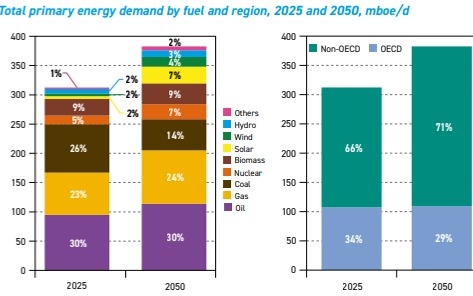
The organization attributes this resilience to a combination of population growth, expanding cities, rising incomes, industrial development, aviation and the petrochemical sector, particularly in emerging economies.
Nearly three billion vehicles, but most will still use conventional engines
The global vehicle fleet is expected to grow from 1.75 billion vehicles in 2025 to almost three billion by 2050 as car ownership expands across developing countries.
Electric vehicles will be the fastest-growing segment, with their number projected to rise from around 70 million to 634 million. China alone is expected to have more than 240 million electric vehicles by the middle of the century.
However, OPEC does not expect electrification to end the dominance of conventional vehicles.
Gasoline, diesel, LPG-powered and hybrid vehicles are projected to number around 2.2 billion in 2050, representing approximately 73% of the global fleet.
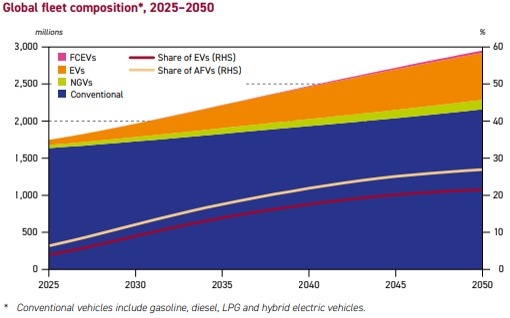
This means that even after hundreds of millions of electric vehicles enter the market, the number of vehicles using conventional fuels could still be higher than it is today.
Hydrogen fuel-cell vehicles are expected to remain a niche part of the market, reaching around 30 million units by 2050. OPEC points to the high cost of hydrogen, limited supplies and insufficient refueling infrastructure as the main barriers to faster adoption.
India emerges as the new center of oil demand growth
The long-term oil market is also expected to shift decisively toward developing economies.
Demand in countries outside the OECD is forecast to increase by 26.9 million barrels per day, from 59.2 million in 2025 to 86.1 million in 2050.
Over the same period, consumption in OECD countries is projected to fall by 7.9 million barrels per day to 38 million.
India will account for the largest share of additional demand. Its oil consumption is expected to more than double from 5.6 million barrels per day in 2025 to 13.8 million by 2050, adding 8.1 million barrels per day.
Other Asian economies will add another 5.3 million barrels per day, while demand in the Middle East is projected to grow by 4.7 million and in Africa by 4.3 million. Latin America will add 2.8 million barrels per day.
China, which has been one of the main engines of oil demand growth in recent decades, is expected to follow a different path. Its consumption is projected to rise from 16.9 million barrels per day in 2025 to a peak of around 18.9 million in the 2030s, before easing to 18 million by 2050.
Meanwhile, oil demand in OECD Europe is forecast to decline from 13.4 million barrels per day to 10.2 million. In OECD Americas, it is expected to fall from 25.4 million to 22.4 million.
Aviation, petrochemicals and road transport keep oil demand growing
The transport sector will remain central to future consumption. OPEC expects road transport demand to increase by 5.7 million barrels per day between 2025 and 2050, the largest contribution from any individual sector.
Petrochemicals will add 4.6 million barrels per day, while aviation demand is projected to grow by 4.2 million as passenger traffic and air freight expand.
Demand will also rise in industry and in the residential, commercial and agricultural sectors.
Electricity generation is the only major sector in which oil consumption is expected to decline, falling by around 500,000 barrels per day as power producers shift to natural gas, nuclear energy and renewables.
Among petroleum products, jet fuel and kerosene will record the largest increase, adding 4.2 million barrels per day.
Diesel and gasoil demand will rise by 3.8 million barrels per day, followed by LPG and ethane at 3.5 million, naphtha at 3.2 million and gasoline at 2.4 million.
The forecast shows that future oil demand will increasingly depend not only on passenger cars, but also on aviation, freight, plastics, chemicals and industrial production.
Renewables grow fastest, but do not replace oil and gas
OPEC expects renewable energy to record the strongest growth of any part of the energy system.
Combined demand for biomass, solar, wind, hydropower and other renewable sources is projected to increase by 51.3 million barrels of oil equivalent per day by 2050. Their share of the global energy mix will rise from around 15% in 2025 to approximately 26% in 2050.
Solar and wind will account for most of the expansion, supported by falling production costs and government incentives. Electricity generated from wind and solar is forecast to surge from around 5,400 terawatt-hours in 2025 to approximately 26,000 terawatt-hours by 2050.
Overall global electricity generation will rise by more than 85%, from around 32,000 terawatt-hours to 59,500 terawatt-hours. Around three-quarters of that growth will come from developing countries, with developing Asian economies alone accounting for almost 60% of the global increase. Homes, factories, electric vehicles and data centers will all push electricity consumption higher.
However, OPEC argues that the growth of renewables will add to the global energy system rather than fully replace conventional fuels.
Natural gas demand is projected to rise by 19.3 million barrels of oil equivalent per day, while oil will add 18.6 million. Nuclear energy will increase by 10.5 million after years of relatively limited growth.
Coal is the only major energy source expected to decline. Its consumption is projected to fall by 29.3 million barrels of oil equivalent per day as it is displaced in electricity generation.
Population and data centers push global energy use higher
The expected rise in oil consumption forms part of a much broader expansion in global energy demand.
OPEC projects that primary energy demand will increase by around 23%, from approximately 312 million barrels of oil equivalent per day in 2025 to nearly 383 million in 2050. Almost all of this growth will come from developing regions.
The world’s population is expected to increase by 1.4 billion to almost 9.7 billion by 2050, while the urban population will grow by 1.7 billion. The number of people of working age is projected to rise by 751 million to more than 6.1 billion.
At the same time, the global economy is expected to more than double in size, growing from $177 trillion in 2025 to $359 trillion in 2050, measured in 2021 purchasing power parity terms. Average global GDP per capita will rise from around $21,500 to $37,100.
Alongside traditional drivers such as urbanization and industrialization, OPEC highlights data centers as an increasingly important source of energy consumption.
US tight oil may have already reached its peak
While global oil demand continues to rise, the sources of future production are expected to change. OPEC estimates that US tight crude production may have already peaked in 2025 at slightly above nine million barrels per day.
Total US liquids production is projected to grow by only around 400,000 barrels per day through 2030 before entering a prolonged plateau.
Production outside the countries participating in the OPEC+ Declaration of Cooperation is expected to increase by 4.1 million barrels per day to 58.2 million by 2030. Brazil, Qatar, the United States, Argentina, Canada and emerging African producers will account for most of the additional supply.
However, non-OPEC+ production is forecast to peak during the 2030s and remain close to 60 million barrels per day. By 2050, it is expected to stand at 59.6 million.
Production by countries participating in the Declaration of Cooperation is projected to rise more strongly, from 50.6 million barrels per day in 2025 to 64.5 million in 2050. Their share of global liquids supply would consequently increase from 48% to around 52%, strengthening the group’s long-term role in the international oil market.
Oil industry faces a $17.7 trillion investment bill
OPEC says the expected rise in consumption cannot be met without massive investment in exploration, production, pipelines and refineries.
“For oil alone, we see the need for investment of $17.7 trillion from 2026 to 2050,” Al Ghais said.
Around $14.5 trillion will be required for upstream activities, including the development of new fields and maintaining production at existing ones.
A further $1.9 trillion will be needed for refining, while approximately $1.3 trillion must be invested in pipelines, storage and other midstream infrastructure.
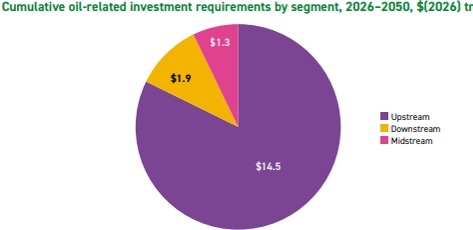
The total is equivalent to more than $700 billion a year.
The center of global refining moves east
The geographical shift in demand will also reshape the refining industry. Around 4.9 million barrels per day of refinery capacity from existing projects is expected to enter operation between 2026 and 2030.
The Asia-Pacific region will account for approximately 2.8 million barrels per day of that total, followed by the Middle East with one million and Africa with 800,000. Together, the three regions will represent around 94% of all new refinery capacity scheduled to open during the period.
Meanwhile, refineries in developed economies are expected to face growing pressure from declining domestic fuel demand and increased competition from newer plants in Asia and the Middle East.
Between 2026 and 2050, the world will require an estimated 19.3 million barrels per day of additional crude distillation capacity.
The forecast could still change
OPEC stresses that its central forecast is not the only possible outcome. Under a Technology-Driven Scenario, faster electrification, greater energy efficiency and accelerated growth in renewable and nuclear power would reduce global primary energy demand by around 43 million barrels of oil equivalent per day compared with the Reference Case in 2050.
Under that scenario, renewables and nuclear energy would together account for almost 45% of the global energy mix. In contrast, stronger economic development across Africa, India, Asia and Latin America could lift energy demand by around 17 million barrels of oil equivalent per day above the central forecast.
The alternative scenarios underline how strongly the future energy market will depend on technology, government policy, economic growth and access to energy. In its main scenario, however, OPEC concludes that population growth, expanding transport networks, industrial development and rising living standards will keep global oil demand growing through 2050.
Earlier, Qazinform News Agency reported that Kazakhstan and six other OPEC+ countries agreed to increase oil production by 188,000 barrels per day in July 2026.