Kazakhstan to upgrade over 976 km of water canals by 2026 end
The Kazakh Government is actively advancing the president’s water infrastructure directive. The initiative involves building new reservoirs, upgrading canals and water supplies, and implementing digital water tracking to ensure resources are used efficiently, Qazinform News Agency reports, citing the Government’s press service.
According to the Government, Kazakhstan launched 22 major water infrastructure projects in 2025 with a combined value of more than 218 billion tenge. These projects included the construction of 14 regional water pipelines and eight water supply facilities, improving access to clean drinking water for 321 rural settlements with a population of over 945,000 people.
A major focus of the program is the reconstruction and reinforcement of reservoirs, dams, and flood-control facilities. Work has been carried out on key sites including the Aktobe reservoir in Aktobe region, the Kyzylagash reservoir dam in Zhetisu region, the Charsk reservoir in Abai region, the Kirov reservoir in West Kazakhstan region, and the Kapshagay reservoir in Turkistan region.
Several new water facilities are also scheduled for completion, including the Karakuys and Baidibek Ata reservoirs in Turkistan region, the Zhabay river storage pond in Akmola region, and the Andas-3 pond in Zhambyl region. These projects are expected to improve water storage capacity and strengthen protection against flooding.
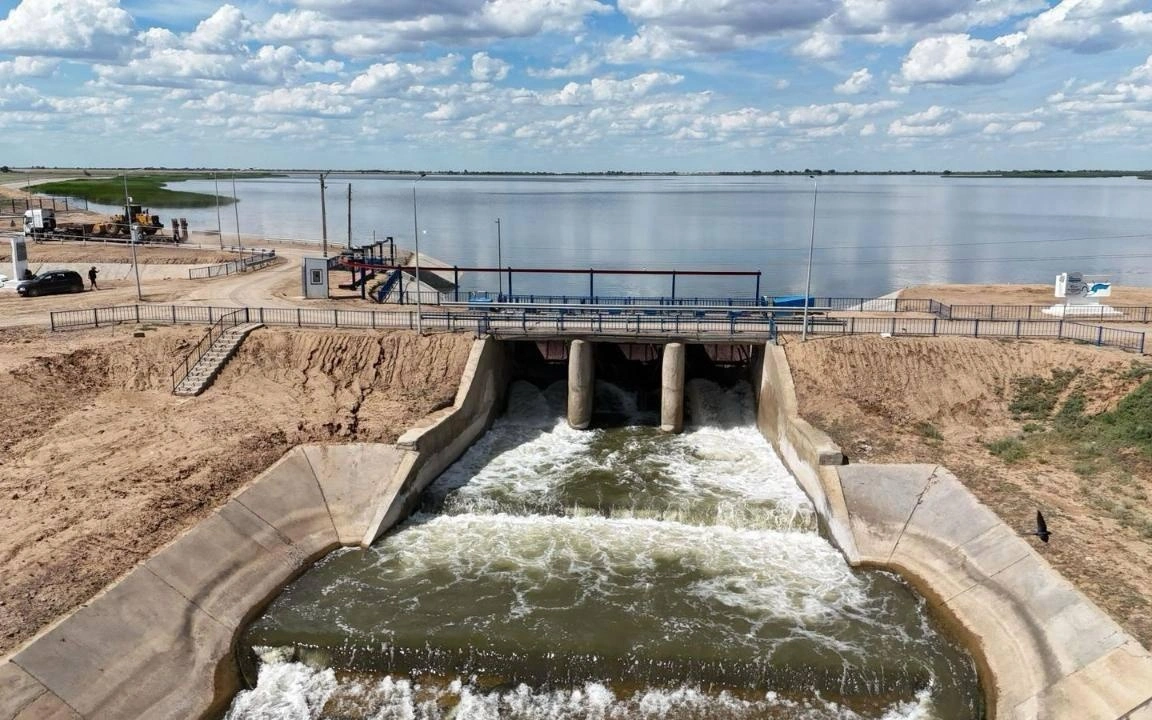
Canal modernization remains one of the government’s key priorities. During the first six months of 2026, 206.19 kilometers of canals were reconstructed, while the total target for the year exceeds 976 kilometers - significantly higher than the 680 kilometers renovated throughout 2025.
Recent upgrades have already improved irrigation efficiency in several regions. In Almaty region, authorities completed repairs on 1.5 kilometers of damaged sections of the Konayev water canal and commissioned the renovated 26-kilometer Naiman canal, which includes 75 hydraulic structures. The project helped reduce water losses and improved irrigation conditions for more than 33,000 hectares of agricultural land.
Kazakhstan is also expanding digital management of water resources. The Ministry of Water Resources and Irrigation introduced electronic contracts with the state enterprise Kazvodkhoz, and more than 28,000 agreements have already been registered through the national Billing digital platform. The system is designed to make water distribution more transparent and improve monitoring of consumption.
During the 2025 irrigation season, around 11.1 billion cubic meters of water were used to irrigate 1.2 million hectares of farmland, with 97 percent of consumption concentrated in southern regions. For the current season, officials expect water usage to remain at a similar level while improving efficiency through conservation measures.
To improve forecasting, Kazakhstan is introducing the TALSIM hydrological model, developed with support from the United Nations Development Programme (UNDP). The system accurately predicted water inflows on the Esil and Nura rivers with an 85 percent success rate during previous spring flooding. By the end of 2026, forecasts are expected to cover 14 major river basins.
The government is also promoting a culture of responsible water use through education and public initiatives. With support from UNICEF, environmental lessons have been introduced in universities, colleges, and schools, reaching more than 3.3 million students. Under the Taza Qazaqstan environmental initiative, thousands of volunteers have cleaned water sources and protected coastal areas across several regions.
Farmers are receiving additional support to adopt water-saving technologies. The government increased reimbursement for irrigation modernization expenses from 50 percent to 80 percent and introduced a new subsidy system linked to water tariffs.
Kazakhstan has also launched the first phase of the Development of Climate-Resilient Water Resources project. The initiative includes the construction of three new reservoirs in Zhambyl, Kyzylorda, and West Kazakhstan regions, reconstruction of existing reservoirs, and modernization of 103 canals with a combined length of nearly 979 kilometers. International partners have provided more than 15.9 million US dollars in grant funding to support these efforts.
Furthermore, in Turkшstan region, to supply five districts with drinking water, a group water pipeline with a cascade of HPPs (hydropower plants) on the Ugam river is planned to be constructed via a PPP (Public-Private Partnership) mechanism, at an estimated cost of 191.7 billion tenge.
Earlier, Qazinform reported Kazakhstan is to upgrade water supply for 200,000 hectares of irrigated land by the 2026 end.