Japan’s hospital dogs offer comfort and normalcy to sick children
When a Labrador retriever named Masa entered a pediatric ward in Tokyo, the atmosphere instantly changed — children’s faces lit up with joy, Qazinform News Agency cites Kyodo.

Masa is one of Japan’s few facility dogs, specially trained to support children enduring long hospital stays or awaiting organ transplants. Working alongside medical staff, these dogs provide companionship tailored to each child’s treatment plan, helping restore a sense of normal life inside the hospital.
Although the concept was introduced in Japan about 15 years ago, facility dogs remain rare due to high costs. Each dog requires around 10 million yen annually for care and personnel expenses, with hospitals relying heavily on donations.
At the National Center for Child Health and Development, Masa recently joined young patients in play. Three-year-old Rui Hiyama, hospitalized for nearly a year while receiving cancer treatment, pretended to give him a toy injection before taking him for a short walk around the ward. “Even though she’s confined to the ward, she lights up whenever she plays with Masa,” her mother said.
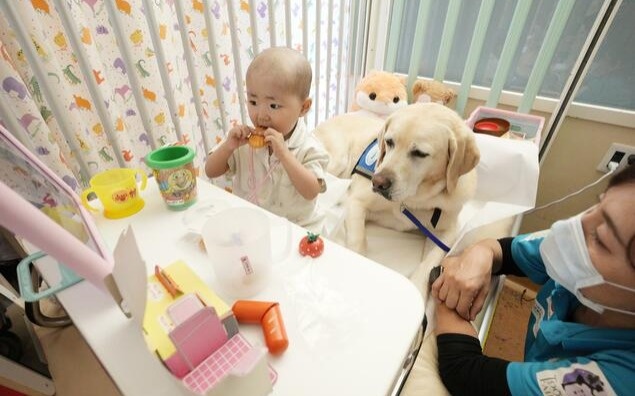
The dog’s presence also helps children cope with medical procedures. “Masa is a hero,” said an 11-year-old boy, recalling how the retriever distracted him during frightening tests by playing Jenga together.
Masa’s handler, Ayami Gonnokami, a pediatric nurse with 25 years of experience, coordinates closely with doctors to ensure the dog’s interactions are therapeutic. She explained that some children withdraw during painful treatments, but Masa’s calm companionship helps them reconnect. In one case, a bedridden child managed to walk after spending time with him.
“Time with Masa is when a child can simply be a child again, free from the attributes of illness,” said Nobuyuki Yotani, head of the hospital’s palliative care department.
The nonprofit Shine On! Kids, which launched the program in 2010 at Shizuoka Children’s Hospital, currently places one dog at each of four hospitals in Tokyo and Kanagawa Prefecture. It aims to introduce facility dogs to all 15 pediatric cancer hospitals in Japan.
To achieve this, the organization hopes to collect medical data proving the effectiveness of facility dogs and lobby for government support to include the program in Japan’s medical fee system.
To note, researchers in Australia find potential treatment to bypass resistance in deadly childhood cancer.