Dubai's population surpasses 4.58 million, up 7.5%
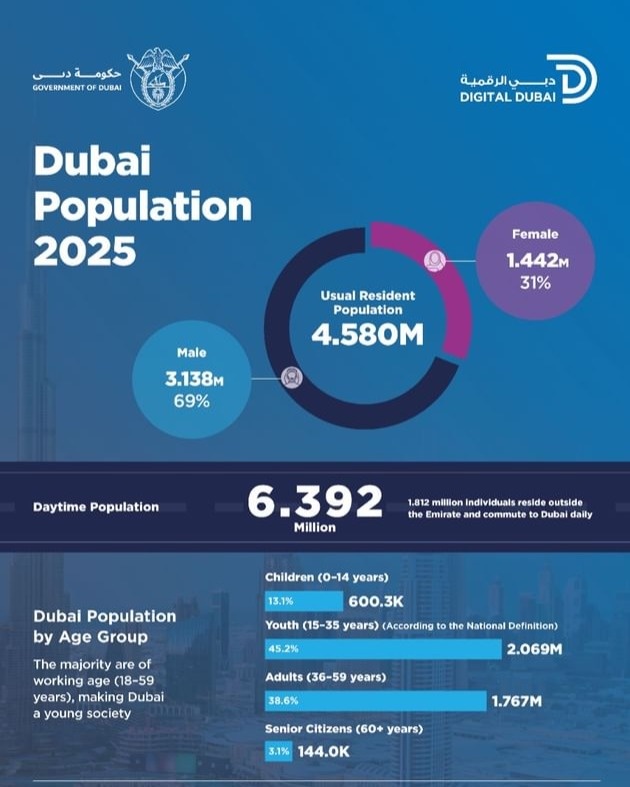
Digital Dubai, through the Dubai Data and Statistics Establishment, announced that the population of the Emirate of Dubai reached 4.58 million by the end of 2025, up around 332,000 people year-on-year at a growth rate of 7.5 percent, WAM reports.

The average number of people present in the emirate during daytime hours rises to 6.392 million when temporary arrivals for work and tourism are included. The announcement coincided with the approval by H.H. Sheikh Hamdan bin Mohammed bin Rashid Al Maktoum, Crown Prince of Dubai, Deputy Prime Minister, Minister of Defence and Chairman of the Executive Council of Dubai, of the real-time census and population growth monitoring project in Dubai.
The project is based on an advanced digital methodology considering administrative records, smart systems and real-time data, representing a qualitative shift in measuring the population landscape and enhancing the ability of government entities to plan and make decisions more accurately and rapidly, away from traditional census methods.
Hamad Obaid Al Mansoori, Director-General of Digital Dubai, said the project is a new strategic milestone in Dubai’s journey towards consolidating a global model for a data- and artificial intelligence-driven digital government.
He affirmed that data has become a national asset and strategic infrastructure supporting decision-making, improving planning efficiency and strengthening the ability to anticipate the future.
He added that the project embodies Dubai’s vision of harnessing advanced technologies to build an interconnected digital ecosystem based on reliable and continuously updated real-time data, enabling government entities to develop more precise policies, more proactive services and more efficient investments, while enhancing the emirate’s readiness to sustain growth across various sectors.
Younus Al Nasser, Chief Executive Officer of the Dubai Data and Statistics Establishment, said the “Dubai Population Now” initiative goes beyond providing accurate and updated population data to become a strategic tool for understanding the population landscape, anticipating changes and supporting smarter decision-making.
He explained that population growth reflects the vitality of Dubai’s economy, which recorded real gross domestic product growth of 5.4 percent in 2025, alongside the emirate attracting 19.6 million international tourists and around 96 million passengers traveling through Dubai airports during the same year.
He affirmed that the population increase reflects the expansion of the labour market, rising demand for services and improved quality of life.
Al Nasser noted that Dubai attracts large numbers of workers and visitors every day from within and outside the country, raising the number of people present in the emirate during peak hours to 6.392 million.
This includes more than 1.812 million people temporarily present for work, tourism, study or shopping, which represents a key factor in planning infrastructure, transport networks and public services.
Digital Dubai affirmed that the project represents a new generation of population censuses, relying on the integration of government records, big data, artificial intelligence and machine-learning technologies.
This enables data to be updated continuously, demographic trends to be forecast and planning to be improved across the housing, education, healthcare and transport sectors.
The project was implemented through cooperation among several government entities in the emirate, including the General Directorate of Residency and Foreigners Affairs-Dubai, the Roads and Transport Authority, Dubai Electricity and Water Authority, Dubai Health Authority, Dubai Municipality, Dubai Land Department, the Knowledge and Human Development Authority, the Department of Economy and Tourism and the Dubai Government Human Resources Department.
This model reflects the integration of government work in developing an advanced population data ecosystem.
The shift to a real-time census reflects Dubai’s progress in managing population data after seven traditional censuses between 1975 and 2005.
The emirate’s population rose from around 12,000 people in 1881 to more than 4.58 million by the end of 2025, representing an increase of nearly 380-fold over 144 years.
The current growth rate of 7.5 percent is among the highest recorded in the emirate’s history, reaffirming Dubai’s position as one of the world’s fastest-growing cities and one of the most attractive destinations for residents, investment and talent.
As Qazinform News Agency reported earlier, Dubai home rents slip 6.2% despite higher property prices.