Banks are trusted again. What changed?
Almost two decades after the 2008 global financial crisis shook the world economy, trust in banks has not only recovered but reached a new high in the countries that suffered most, Qazinform News Agency correspondent reports.

According to data from the Gallup World Poll, 63% of people in the 25 hardest hit countries said in 2025 that they have confidence in their financial institutions and banks. This is the highest level recorded since the crisis.
Before the crisis, 57% of people in these countries trusted banks. That number fell sharply to 40% in 2009 and dropped further to 37% in 2012, marking its lowest point during the eurozone crisis. Trust then began to recover gradually, reaching 56% in 2020 before climbing to a new peak of 63% in 2025.
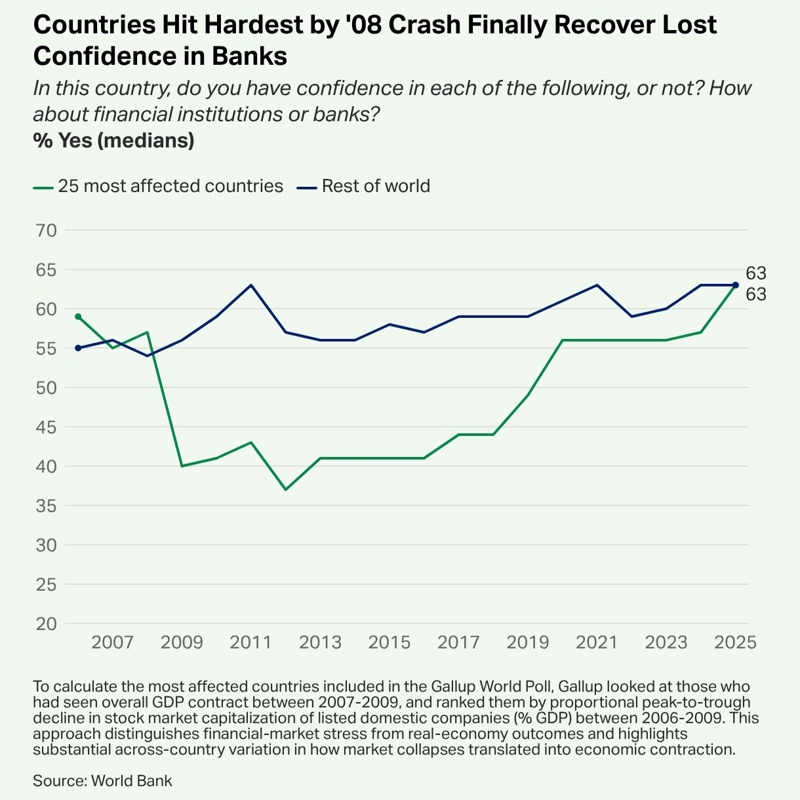
The drop in confidence was strongest in countries with large financial sectors and heavy exposure to the crash. These were nations where stock markets plunged and economies shrank between 2006 and 2009.
In contrast, countries with smaller financial sectors did not see the same decline. In many of them, trust in banks even increased between 2008 and 2011. Now, for the first time since the crisis, the hardest hit countries have caught up with the rest of the world in public confidence.
Banks climb back up the trust rankings
Before the crisis, banks were among the most trusted national institutions in the 25 countries that suffered the largest financial sector losses during the 2008 crash. Only the military ranked higher.
That changed in 2009, when trust in banks fell to levels similar to trust in national governments, which were among the least trusted institutions at the time.
For about a decade, banks and governments remained near the bottom of trust rankings. But as confidence slowly returned, banks regained their standing. By 2025, they were once again among the more trusted institutions, on par with electoral systems.
What helped restore trust
After the crash, many countries introduced stricter rules for banks. These included stronger oversight and higher financial requirements. In countries such as Ireland, Greece, and Portugal, reforms were often tied to financial support from the European Union. But regulation alone may not explain the recovery.
Across the 25 countries, rising trust in banks closely matched improvements in how people felt about their household income. As people felt more financially secure, their confidence in banks also increased.
Different paths in different countries
The recovery did not look the same everywhere.
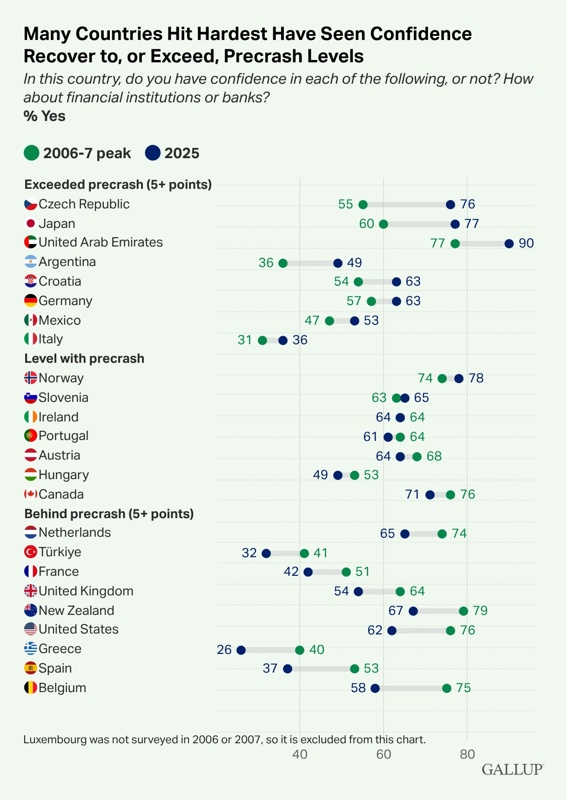
Eight countries, including Germany, Italy, Japan, and Mexico, now show trust levels at least five points higher than before the crash.
Seven others, including Austria, Hungary, and Slovenia, are close to their pre-crisis levels.
However, in nine countries trust remains at least five points lower than before 2008. These include Belgium, Spain, Greece, and the United States. In these nations, 2025 levels are at least 14 points below their pre-crisis peaks.
Ireland saw the most dramatic swing. Trust in banks there fell by 43 points between 2008 and 2009, the largest single year drop ever recorded. In 2011, only 13% of people said they trusted banks.
Since then, trust has climbed by 51 points to reach 64% in 2025.
This rebound is striking given that Ireland’s banking sector lost nearly 75% of its stock market value during the crash, and its economy shrank by 9%.
Earlier, Qazinform News Agency reported that Britain ranked first in the world for immigration concern.