Astana hosts a discussion on AI and scientific collaboration between Kazakhstan and Spain
Astana hosted an educational event on academic and scientific cooperation between Kazakhstan and Spain, bringing together scholars, diplomats, and students. The discussions centered on artificial intelligence, interdisciplinary research, and the growing partnership between the two countries in education and science, Qazinform News Agency correspondent reports.

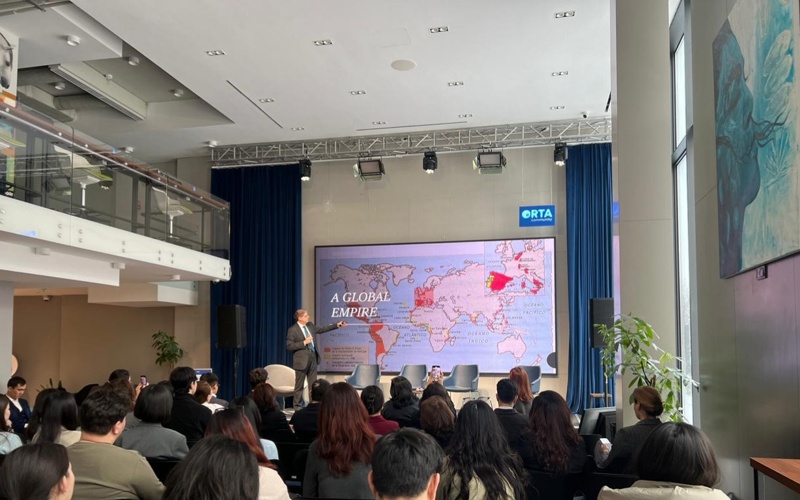
The event opened with a lecture by Ambassador of Spain to Kazakhstan, Kyrgyzstan, and Tajikistan Luis Francisco Martínez Montes, who spoke about Spain’s historical contributions to science and innovation. He highlighted achievements ranging from early humanitarian vaccination expeditions to medical and technological breakthroughs, emphasizing the role of science as a foundation for international cooperation.
The panel discussion that followed featured researchers from Nazarbayev University, who shared their perspectives on artificial intelligence, education, and interdisciplinary development.
Daniel Hernández-Torrano, Vice-Dean for Research, shared his thoughts on the potential of applying data science and AI beyond traditional technology fields. Drawing on his background in education, he emphasized that AI could fundamentally transform learning.
“You will be able to get educated exactly on what you care about and individualize your learning. Now you don't have to pay a lot of money to get an expensive tutor to specialize in this. With AI, you will have that at the tip of your fingers. There is potential for virtual tutors and automated grading. As a professor, I would love to see a system that allows me to grade the papers of my students in seconds rather than in hours or days. That is taking place now, and that’s what we’re doing with professors these days at the end of the semester. VR in education - lots of potential for the field. So, to make the answer short and to finish, I would perhaps choose a data science profession and apply it to education. I think there is huge potential, so I invite you to consider that option,” Hernández-Torrano said.
Dean of the School of Humanities Gonzalo Hortelano Hap focused on adaptability in a rapidly changing world shaped by AI technologies. He stressed that modern education should prioritize the ability to learn continuously rather than following rigid, predetermined career paths.
“Today, the key is to learn how to learn. You pick a program that helps you get used to that, because society changes so quickly that tomorrow you’ll be left behind. So it is best if you pick something you’re really passionate about. If you're not passionate - those of you with kids know this - if you force them to do something, as long as you’re not forcing them, they will not do it. It is best if you choose something with real passion, whatever it is,” Hortelano Hap stated.
Aida Kabibulatova, cardiologist and PhD candidate in Global Health, highlighted the integration of artificial intelligence into everyday life and medical research. She cited her own work in genomics as an example of how AI is already enabling more personalized approaches to healthcare.
“There are multiple AI tools that help you identify specific genes to predict or make personalized treatment for a particular disease, for a patient or a person. The integration of AI into our daily routine and our research is immense. We are also adapting. That’s why I'm choosing - and will continue choosing - the research field. You are accepting these novelties more easily, and as a researcher, you always love to investigate something, you want to know. I recommend all of you to always stay curious about everything, do not stop being curious. And this word passion that you used - I will add Spanish passion. Always use this Spanish passion for your work, for your field, to make it your interest and the hobby of your life. That’s how you will easily integrate all novelties and AI tools into any path you choose,” Kabibulatova said, emphasizing adaptation rather than fear of AI-driven change.
Hernández-Torrano also presented data on scientific collaboration between Kazakhstan and Spain, noting a sharp increase over the past decade. According to his analysis, annual joint publications grew significantly after 2015, reaching around 150 collaborative studies per year, with key research areas including global health, engineering, environmental sciences, and physics.
Speaking about academic cooperation, Ambassador Martínez Montes emphasized the openness of Spain’s higher education system and the importance of student mobility programs, while also underlining the value of multilingualism in science and education.
“English was becoming, even at the beginning of the 20th century, the global language of science, but it does not have to be to the detriment of other important languages, including Kazakh. So my advice is that you do the same - combine both English and your local language,” he said, encouraging students to balance global engagement with local identity while taking advantage of academic exchange opportunities between Spain and Kazakhstan.
Earlier, Qazinform News Agency reported that Kazakhstan’s Ambassador to Spain, Danat Mussayev, discussed opportunities for scientific cooperation with the Vice President of the Spanish National Research Council (CSIC), Isabel Díaz.