Saxaul plantations cover 672,000 ha of Aral Sea bed in 4 years
As part of efforts to combat desertification in southern Kazakhstan, saxaul planting was undertaken on 672,000 ha of the dried Aral Sea bed between 2021 and 2024, Qazinform News Agency reports, citing the Project Office for Central Asia on Climate Change and Green Energy.
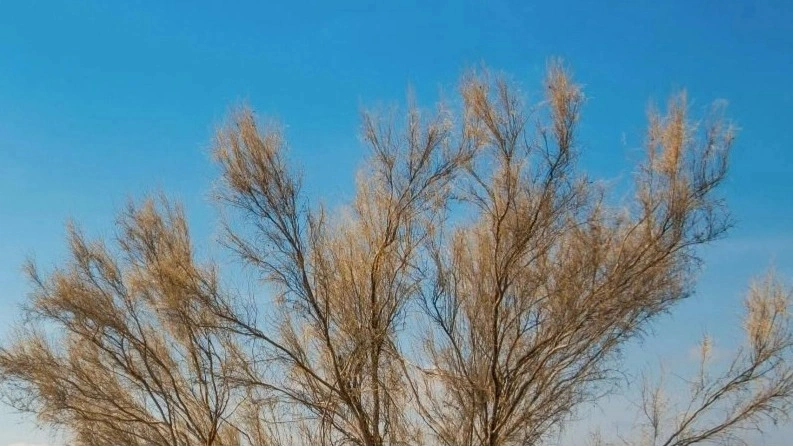
The national report on the state of the environment and the use of natural resources of the Republic of Kazakhstan identifies forest melioration as one of the most effective ways to combat desertification. Accordingly, saxaul planting has been under way on the dried Aral Sea bed for several years.
Data from the Forestry and Wildlife Committee show that the dried Aral Sea bed covers a total area of 6 million ha, with 2.8 million ha located in Kazakhstan.
Over the four-year period, forest melioration works were carried out across 672,000 ha of the dried seabed, including 101,000 ha in 2021, 250,000 ha in 2022, 194,000 ha in 2023 and 127,000 ha in 2024. The work forms part of a directive from the Head of State to establish saxaul plantations on 1.1 million ha by 2025.
As part of efforts to secure planting material, a 33-hectare nursery was constructed in 2024 in Kazaly with financing from the World Bank. It is capable of producing up to 3 million saxaul and halophytic shrub seedlings annually.
Kazakhstan’s Ministry of Ecology and Natural Resources is also constructing a forest nursery on the dried Aral Sea bed, with scientific support. Covering 15 ha, the facility will have an annual capacity of up to 1.5 million saxaul seedlings adapted to arid conditions.
Overall, forest melioration measures aim to reduce dust storms, restore degraded land, and create resilient ecosystems.
Earlier, Qazinform News Agency reported that, while addressing the Fifth Ulttyq Qurultay in Kyzylorda, President of Kazakhstan Kassym-Jomart Tokayev focused on the issue of the Aral Sea, emphasizing its global significance.