Kazakhstan’s constitutional reform is a driver of institutional stability and regional trust, says Armenian expert
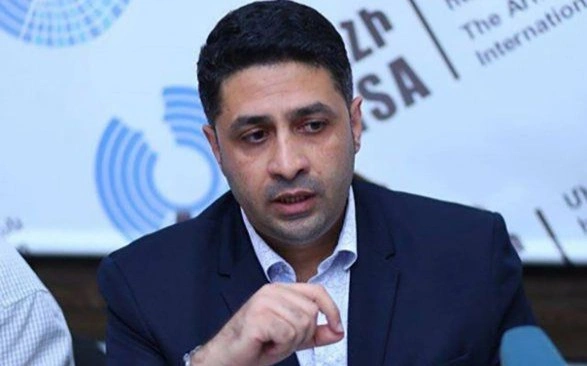
The trajectory of Kazakhstan’s constitutional reform is increasingly seen as a factor influencing governance stability and political predictability beyond the country’s borders. In an exclusive interview, Gevorg Melikyan, Head of the Armenian Institute for Sustainability and Public Administration, told Qazinform News Agency how the reform is assessed in Armenia and what it means for bilateral and regional cooperation.
From the perspective of the Armenian expert community, how do you assess Kazakhstan’s constitutional reform in terms of its contribution to long-term institutional resilience and the quality of public governance?
— From the perspective of the Armenian expert community, Kazakhstan’s constitutional reform appears not as a set of fragmented amendments, but as an attempt to construct a coherent model of a resilient state in the context of the systemic crises of the 21st century. What is fundamentally important is the shift from targeted adjustments to a rethinking of the entire architecture of public governance: the redistribution of powers, the strengthening of parliament’s role, the institutionalization of new bodies (the Qurultay, the Khalyq Kenesi, and the vice presidency), as well as the consolidation of a human-centric approach. This creates preconditions for improving governability and predictability within the political system, which is a key requirement for institutional resilience.
Comparative post-Soviet experience shows that formal reforms without a change in the logic of governance often remain imitative. In this context, Kazakhstan’s approach appears more mature, as it is accompanied by an acknowledgment of governance failures, competence deficits and the need to dismantle informal clan-based mechanisms. The ban on relatives of the head of state holding key positions, the expansion of parliamentary oversight over the Constitutional Court, the Central Election Commission and the Supreme Audit Chamber, as well as the institutionalization of public participation mechanisms through the Qurultay and the People’s Council, all indicate an effort to genuinely improve governance quality rather than pursue cosmetic modernization.
Kazakhstan maintains a strong presidential model while simultaneously strengthening the role of parliament. From your perspective, how functional and institutionally mature does this balance of power appear in comparative terms across Eurasian countries, including Armenia?
— The model of a “Strong President – Influential Parliament – Accountable Government” in the Eurasian context looks not like dogmatic imitation of Western frameworks, but rather as a pragmatic search for a functional balance. For countries with large territories, complex elite structures and significant geopolitical responsibilities, an abrupt dismantling of the presidential vertical may lead not to democratization, but to governance fragmentation. In this sense, maintaining a strong presidency alongside the institutional strengthening of parliament appears more mature and better adapted to Kazakhstan’s real conditions.
Armenia’s experience following the 2015 constitutional reform demonstrates the risks of formal parliamentarism in the absence of sustainable party competition and program-based politics. The formal empowerment of parliament without party institutionalization, professionalization of political recruitment and effective mechanisms of accountability can result in new forms of personalized power. Kazakhstan’s reform, by contrast, seeks to embed parliamentary strengthening within a system of checks and balances, expanding its real oversight functions and involving it in the formation of key institutions. When combined with a strong presidency, this may create a more stable and manageable balance of power than abrupt institutional ruptures.
One of the areas of modernization in Kazakhstan is improving the efficiency of public administration, including through digitalization and managerial innovation. To what extent do constitutional changes create a sustainable framework for these processes when viewed from the outside — by partner states?
— From an external observer’s perspective, Kazakhstan’s constitutional changes can create a fairly robust framework for modernization, including through digitalization and managerial innovation. What is particularly important is that the digital agenda and personal data protection are enshrined not only at the level of policy documents, but also within the logic of constitutional guarantees, including the recognition of data and digital infrastructure as elements of national security. This indicates a shift from digitalization rhetoric to the institutional embedding of technology within the public governance system.
Additional resilience is provided by the transition to a “managerial state” model, where efficiency, performance monitoring and digital tools are viewed as elements of managerial rationality rather than a modernization showcase. In the Eurasian context, where digitalization is often used as a symbol of reform without changing decision-making logic, Kazakhstan’s approach appears more applied and pragmatic. For partner states, this signals that Kazakhstan seeks to build a manageable, technologically adaptive system capable not only of responding to crises, but of systematically improving governance quality.
Kazakhstan is positioning itself as a predictable and pragmatic partner, actively engaging in integration formats. To what extent does internal institutional modernization, including constitutional reform, contribute to strengthening trust and expanding cooperation between Kazakhstan and its partners, including Armenia?
— Foreign policy predictability directly depends on internal institutional resilience. Kazakhstan’s constitutional reform, aimed at improving governability, dismantling informal influence mechanisms and institutionalizing power succession — including the idea of a vice presidency — reduces the risks of sudden political turbulence. For partners, including Armenia, this translates into greater predictability of decisions, stability of commitments and lower transactional risks in both bilateral and multilateral cooperation.
It is also important that Kazakhstan consciously avoids aggressive foreign policy rhetoric, positioning itself as an autonomous, pragmatic and influential actor. This approach becomes more convincing precisely against the backdrop of internal institutional modernization: external predictability rests on internal resilience. For the Armenian side, this opens additional opportunities to expand cooperation in areas such as the economy, energy, digital projects and humanitarian interaction, as partnership is built not around personal arrangements, but around a more sustainable and institutionally structured model of the state.
Earlier Akramjon Ne’matov, First Deputy Director of the Institute for Strategic and Interregional Studies under the President of the Republic of Uzbekistan, told Qazinform News Agency about the growing alignment of Kazakhstan’s and Uzbekistan’s modernization strategies and their impact on Central Asia’s sustainable growth.